Why DPP Matters: From Compliance Requirement to Scalable Capability

The idea is simple: scanning a QR code on a product opens its digital record. It shows what the product is made of, where it comes from and how it can be repaired, reused or recycled. This is the goal that companies are working towards with the digital product passport (DPP).
This is what a Digital Product Passport (DPP) is: a product-specific digital record, linked to the physical product through a data carrier. Depending on the product category and the role of the person scanning, repairers, recyclers and customs authorities can access further information. Every scan is part of a long data chain. Every piece of information displayed to the user must originate from a reliable source, such as a supplier, an internal system, or a test report. For this reason, the legal obligation marks only the starting point and opens the way to a scalable product-data capability.
With the DPP, the European Union intends to advance sustainability, circularity, and regulatory compliance. Its central registry, the EU DPP Registry, has been operational since July 20, 2026.
This article covers three key points:
- A shared framework with a fixed first date: The ESPR, which has been in force since July 18, 2024, establishes one architecture for all passports. The EU DPP Registry has been operational since July 20, 2026. Product-specific requirements follow category by category, beginning with batteries on February 18, 2027.
- Reliable data as the decisive factor: The product data collected for the DPP also supports repair, resale, recycling, and customer trust. The quality of this data depends largely on suppliers, which makes early data mapping and supplier collection the most time-critical tasks.
- One governed record for several obligations: Further obligations such as packaging law, product carbon footprints and CBAM rely on much of the same underlying product information as the passport. Maintaining it once in a single record, with one current value per attribute, allows companies to reuse it whenever a new requirement arrives.
A legal requirement that is already taking shape
The Ecodesign for Sustainable Products Regulation (ESPR) establishes a shared framework for product passports, including a unique identifier, physical data carrier, central EU registry, access rights, and an independent backup copy.
What a passport has to contain depends on the product group. For most groups, ESPR delegated acts set the requirements for one category at a time. For others, standalone EU laws define the content, including the Battery Regulation and the Construction Products Regulation. The European Commission’s working plan sets the order in which product groups are addressed: iron and steel in 2026, followed by textiles, aluminum and tires in 2027, furniture in 2028, and mattresses and ICT products in 2029. Energy-related products are scheduled between 2026 and 2029.
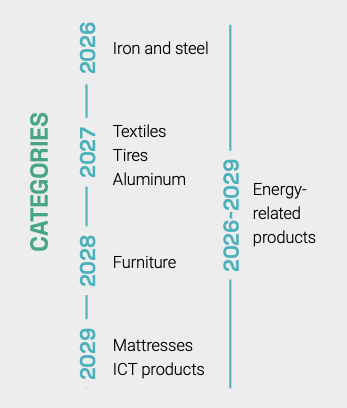
Batteries are the first category with a fixed date: the Digital Battery Product Passport becomes mandatory for most of the batteries on February 18, 2027. The remaining product groups follow through ESPR delegated acts, which will set their application dates after a transition period of at least 18 months.
Beyond compliance: trust as the strongest benefit
Compliance is the primary driver for implementing a DPP. Companies also expect broader benefits from the data and infrastructure behind it, and the one they cite most often is trust. According to KPMG’s European DPP Readiness Survey, 61% of respondents expect a DPP to strengthen trust in their brand or products. Trust grows when customers, business partners, and authorities can rely on verified product information.
Three additional areas are based on the same foundation:
- Regulatory confidence: Authorities reach product information through a standardized point of access, which can make verification and enforcement more efficient and strengthens confidence in the data.
- Repair and resale: Technicians and buyers can see a verified history of what was repaired, replaced, or refurbished.
- Recycling: Machine-readable material composition lets sorting systems act directly on the data.
Each of these benefits rests on the quality of the data behind the passport.
The passport is only as reliable as the product record behind it
The most demanding part of a DPP is gathering the relevant data. Part of it is often available within the company, but it is spread across systems such as ERP, procurement, PLM and compliance tools, frequently in unstructured form, which makes it hard to find and use. The remaining data has to come from suppliers. Collecting it from suppliers and the wider value chain is the most cited implementation challenge (31% in the KPMG survey). Only 19% of companies call themselves well prepared, while 53% are just getting started.
This effort takes time. Even information that suppliers already hold often requires several rounds of follow-up, and every month of waiting shortens the time available for it. Many companies nevertheless wait for the delegated act for their product group before they start. That act defines the product-specific details: which attributes a passport contains, whether it applies at model, batch or item level, who may create or update which data and how long the passport remains available. The foundation is already in place. The ESPR has been in force since July 18, 2024, and its Articles 9 to 14 fix the architecture of every passport: a unique identifier, a physical data carrier, the EU registry, differentiated access rights and an independent back-up copy. The requirement that passport data be accurate, complete and up to date applies regardless of the product group, and six of the eight harmonized DPP standards are already available.
Companies can therefore start preparing today. For a representative product, they can list the attributes a passport is likely to require, map them to their sources and test supplier collection on a few products. The Battery Regulation illustrates why this matters: it fixed February 18, 2027, before most of its implementing detail existed. The three steps at the end of this article show where to begin.
One product record for several obligations
The Digital Product Passport draws on product data that other regulations also require, each with its own format and deadline. Packaging law asks for the materials and weight of packaging. A product carbon footprint is calculated from the bill of materials, together with process, energy and transport data. The Carbon Border Adjustment Mechanism (CBAM) requires embedded emissions for specific imported goods. These obligations are separate from the DPP, yet they share the same underlying product information: materials, suppliers, production context and supporting evidence. Supplier data in particular can be collected once and reused for each of them, provided it is prepared in a structured way.
This is where one governed record becomes valuable. Companies that maintain this information in one governed record, with one current value per attribute, can reuse it for each new requirement. Separate copies in separate systems tend to diverge over time, and conflicting values for the same attribute can become a compliance issue during an audit. A shared record also allows supplier data to be collected once and used for the DPP and every adjacent obligation. Such a foundation, like the osapiens HUB, brings together supplier data collection, traceable evidence, versioned updates and controlled access. It serves the first passports in 2027 and the product groups that follow, and it makes the benefits described above, from repair and resale to recycling, available across the product portfolio. This is the principle behind osapiens HUB for DPP: one live product record that serves the passport, adjacent obligations and every product group that follows.
From compliance project to scalable capability
A shared record brings together supplier data collection, traceable evidence, versioned updates and controlled access. This record supplies the data for the first passports in 2027 and for the product groups that follow.
Three steps help companies build this foundation
- Place your products on the regulatory timeline: Assign each product category in your portfolio to its legal basis, either an ESPR delegated act or a standalone EU law, and to its expected application date. The result shows how much preparation time each part of the portfolio has.
- Run a data gap analysis on one representative product: List every attribute a passport is likely to require and sort it into three groups: held internally, held by a supplier or not yet available anywhere. Supplier-held data usually takes longer to obtain than expected, because even existing information can require substantial follow-up. The result is a gap map that can serve as the basis for the rest of the catalog.
- Name an owner: Data for a passport sits across several systems, suppliers and departments, so one person or team needs to keep an overview. The KPMG shows that in 46% of the participated companies the sustainability teams hold this role today.
With these results in place, companies can test supplier collection on a small number of products and estimate the effort needed to close the remaining gaps.
Want to see what this looks like in practice?
Explore DPP in the osapiens DPP oLab in Cologne or check out the osapiens DPP webinar and all further resources on the osapiens DPP page.