Why osapiens was Positioned as a Leader in Supply Chain Sustainability Software

The Green Quadrant: Supply Chain Sustainability Software (2026) by independent research and advisory firm Verdantix positions osapiens as a Leader. The report benchmarks 16 supply chain sustainability software providers, with the osapiens HUB for Supplier Intelligence evaluated as the relevant osapiens solution.
The assessment comes at a time when supply chain sustainability teams are under growing pressure. According to Verdantix's 2026 global survey, 68% of firms identify compliance with product and supply chain sustainability regulations as a top investment priority, and 79% expect these regulations to be a key driver of investment over the next two years. At the same time, more than 80% of organizations name a lack of high-quality social and environmental data as one of the top three barriers to improving supply chain sustainability.
That data challenge becomes particularly important as companies seek greater visibility beyond their direct suppliers. Buyers increasingly need platforms that can turn fragmented supplier and supply chain data into information they can act on, not simply report on. The full report is available from Verdantix here.
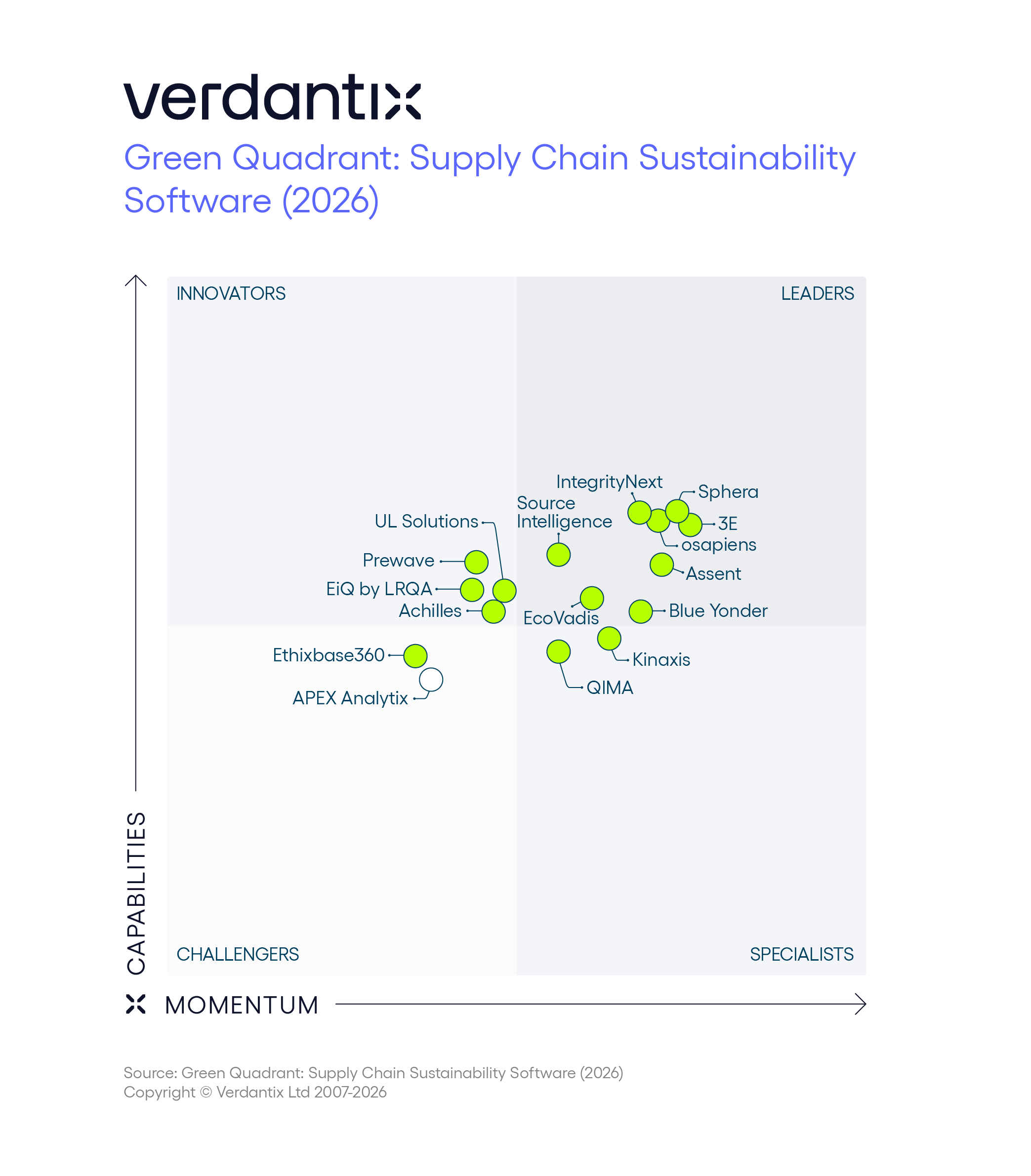
How the report assesses osapiens
The Green Quadrant analysis highlights two capabilities in particular:
First, advanced AI and ML for compliance and risk management. Report authors Elisa Molero and Catalina Fazio write that “osapiens has expanded its agentic AI and machine learning (ML) functionality to support supply chain visibility, sustainability compliance and risk management through automation, predictive analytics and supplier intelligence use cases. For example, within its Supplier Intelligence solution, osapiens leverages ML-powered, satellite-based deforestation detection models that analyse earth observation data at plot level to identify land use change for compliance with the EU Deforestation Regulation (EUDR).”
The report also points to AI-driven task routing that helps direct critical information to the appropriate stakeholders across finance, compliance, sustainability, and procurement. In practice, this reflects the role AI plays across the osapiens HUB for Supplier Intelligence: not as a standalone feature, but as a way to automate analysis and repetitive process steps around supplier intelligence and compliance.
Satellite-based deforestation monitoring is one example. By combining earth observation data with supplier, product, and compliance information, companies can incorporate geospatial analysis directly into EUDR due diligence. Agentic capabilities extend the same principle to operational workflows, where cases, corrective actions, escalations, and progress reporting can be managed with significantly less manual coordination.
The second highlighted area is the unified architecture for cross-functional performance of the osapiens platform. Supplier sustainability information rarely belongs to one department. The same supplier data may be relevant to procurement, compliance, sustainability, product compliance, carbon management, or reporting.
The osapiens HUB is built around one shared data model so that information collected in one process can be reused wherever it is needed. This reduces duplicate data collection and creates a common foundation across functions instead of requiring another point solution and another data model for every new requirement.
Within Supplier Intelligence, this architecture also connects risk identification with action. AI-supported case management can monitor corrective actions, escalate stalled issues, and streamline progress reporting. Risk information therefore does not remain isolated on a dashboard but can become part of a documented mitigation and supplier improvement process.
What the Leader position reflects
The assessment reflects the strategy behind the osapiens HUB: one AI platform where compliance and supplier intelligence workflows draw on the same underlying supplier, product, procurement, carbon, and compliance data rather than operating in separate systems.
This becomes increasingly important as supply chain requirements broaden. Companies need to manage due diligence, deforestation-free sourcing, forced labor requirements, product-level compliance, carbon accounting, and other obligations while also dealing with geopolitical, financial, and environmental risks.
Responding to each of these challenges with another point solution creates fragmented data models and makes it harder to build a consistent picture of upstream supply chains and compliance exposure. The osapiens approach is to capture data once and reuse it across the platform.
For Supplier Intelligence, that starts with knowing the supplier. Companies can onboard and screen suppliers, assess risks, manage audits and corrective actions, and track supplier performance. Risk intelligence can extend beyond tier one to build greater visibility into upstream relationships and the raw materials behind products.
The result is Supplier 360 visibility: a consolidated view of supplier performance, compliance, and resilience, backed by evidence that can be used across procurement and compliance workflows.
This also changes the role of risk management. A risk signal can become a tracked action, with responsibilities and mitigation measures documented through completion. Supplier intelligence therefore moves beyond identifying potential problems toward helping companies systematically manage and reduce their exposure.
One data foundation across compliance and supplier intelligence
The osapiens HUB for Supplier Intelligence shares its data foundation with the wider osapiens HUB.
The same supplier information can therefore feed product compliance, carbon accounting, traceability, and non-financial reporting workflows. Companies do not have to recollect the same information every time another requirement arises, and suppliers do not have to be onboarded again for every new application.
This is the broader platform principle behind osapiens: supplier, product, procurement, carbon, and compliance data is captured once and reused across the areas where it is needed.
The platform also integrates with the systems companies already use, including ERP, PLM, PIM, MDM, and procurement environments. Supplier Intelligence therefore acts as an intelligence layer around existing procurement processes, enriching them with compliance evidence, risk monitoring, n-tier mapping, supplier performance information, carbon data, and regulatory coverage.
For companies facing a growing combination of regulation and supply chain uncertainty, the objective is straightforward: know more about suppliers and upstream supply chains, turn that information into action, and use the same data to manage multiple compliance requirements.
The capabilities highlighted in the 2026 Green Quadrant show how the osapiens HUB for Supplier Intelligence brings these elements together on one AI platform for compliance and supplier intelligence.
Access the full report here: https://www.verdantix.com/venture/report/green-quadrant--supply-chain-sustainability-software-2026