A Practical EUDR Readiness Guide for Exporters to Europe

European buyers are asking exporters for plot-level geolocation and traceability data before they confirm orders. Where an exporter cannot provide it, the buyer cannot file the declaration the shipment requires, and the order does not proceed.
What EUDR is and when it applies
The EU Deforestation Regulation (EUDR) requires companies placing certain commodities on the EU market, or exporting them from the EU, to prove that their products did not contribute to deforestation.
From December 30, 2026, this obligation applies to medium and large operators and traders. Most micro and small enterprises have until June 30, 2027. The regulation covers coffee, cocoa, soy, cattle products, timber, palm oil, rubber, and products made from them.
Before placing an in-scope product on the market, the responsible company must file a due diligence statement (DDS) that declares:
- Where the commodity was grown, by plot coordinates
- That the land was not deforested after December 31, 2020
- That production complied with the laws of the country of origin
- That any remaining risk has been assessed and mitigated
Meeting these declarations depends on data that sits with you as the exporter, not with your EU buyer.
Your data is essential to your buyer's compliance
In export relationships, your EU buyer is the legally responsible party. They file the statement and answer to the competent authority. However, they cannot file it without you. Plot coordinates, harvest records, and the link between a container and a specific farm sit on your side of the supply chain, not in their system.
This is why buyer requests have changed. What used to be an annual sustainability questionnaire is now a shipment-level data request, because buyers need this data on a granular level to effectively meet their EUDR obligations. They will typically ask for:
- Geolocation for every plot behind the shipment
- Traceability linking each batch back to those plots
- Legality and deforestation risk information for their own assessment
As the EU-Mercosur agreement advances, more Latin American goods will enter Europe, and more of them will need a complete compliance package attached.
This leads to a competitive advantage before the regulation takes effect. Exporters who can supply clean, structured data are easier to buy from, while those who cannot might lose orders long before regulation enforcement even begins.
The four pillars of EUDR readiness for Latin American Exporters
EUDR-ready means you can provide your EU buyer with four things for every shipment: geolocation, traceability, risk information, and evidence. Those four map directly onto what your buyer has to do before they can complete their due diligence. They gather information, assess risk, and mitigate anything that is not negligible. Much of the evidence they need comes from your side of the supply chain.
1. Geolocation
Your buyer needs the location of every plot of land where the commodity was produced. The region, cooperative, or the port of departure are not sufficient.
- Coordinates in latitude and longitude, to at least six decimal places
- Plots larger than 4 hectares need a polygon tracing the plot boundary
- Plots of 4 hectares or less can use a single point, though a polygon is strongly preferred
- Cattle need a point for every establishment the animal passed through, across its full lifecycle
- The date or time range of production for each plot
All of this is submitted to the EU Information System in GeoJSON format.
2. Traceability
Geolocation only works if each shipment can be tied back to the specific plots behind it.
- Every batch links to its origin plot or plots
- Where a product draws on several plots, all of them must be listed
- The supply chain holds through aggregation, processing, and export
3. Risk information
Your buyer has to conclude that the risk of non-compliance is negligible. They cannot reach that conclusion on geolocation alone. To fully assess the risk, they need to verify two crucial aspects:
1. Deforestation-free status: The land was not deforested after December 31, 2020, and for timber, the forest was not degraded.
2. Legal production: The commodity complied with the laws of the country of production, covering:
- Land use rights and land tenure
- Environmental protection
- Forest-related rules, where relevant to harvesting
- Third-party rights, including indigenous rights and free, prior and informed consent
- Labor rights and human rights protected under international law
- Tax, anti-corruption, trade, and customs regulations
4. Evidence and documentation
Having the information is not the same as being able to produce it.
- Records must be organized, retrievable, and kept for at least five years
- Documentation must be available to competent authorities on request
- The trail must show not just the conclusion, but how it was reached
Informal assurance does not qualify. A signed supplier declaration stating that no deforestation occurred is not sufficient evidence of deforestation-free production. It merely documents that the supplier made the claim.
Spanish: Explore what EUDR readiness looks like in practice for Latin American exporters.
Portuguese: Explore what EUDR readiness looks like in practice for Latin American exporters.
Operational challenges in EUDR compliance for exporters
The requirements are clear. The difficulty is operational, and within Latin America it concentrates in four main areas.
- Complex and resource-intensive data management: Managing information from hundreds or even thousands of farmers, producers, and suppliers is a highly manual process, and a manual process at that scale is slow and prone to error. Data arriving from different field teams and cooperatives in different formats adds to the work.
- Lack of automated traceability: There is often no clear, centralized process for tracking products and information through the supply chain. Coffee and cocoa are pooled at cooperative and dry mill level, and soy and timber typically pass through traders, crushers, or processors before export. Each of those points combines material from multiple origins, and the link to plot of origin has to be recorded before the material is combined.
- Limited risk mitigation capabilities: Exporters may lack the capacity, tools, or resources to manage and mitigate risks once they are identified, especially where the finding sits with a smallholder several steps upstream.
- Sole responsibility for risk evidence: As the party with the deepest knowledge of products, crops, producers, and plots of land, the exporter is usually the only one who can supply the evidence a buyer needs to assess and mitigate risk, with little room to delegate or share that workload.
A five-step EUDR compliance roadmap for exporters
Many exporters already respond to compliance requests from European customers. What changes under EUDR is the volume and frequency of those requests rather than their difficulty.
Because the due diligence statement is filed per shipment, the same underlying information is requested repeatedly: by each buyer, for every load, covering every plot behind it. For an exporter supplying hundreds of farms across several European buyers, this can add up to thousands of these exchanges over a single season.
In most cases, this is a question of process design. It is stored as individual documents instead of as a group of related documents.
The five steps below follow the order in which the data is created. Each depends on the accuracy of the one before it.
Step 1. Collect and validate geolocation data
Capture the boundary of every plot supplying EU-bound product, together with production dates, in a format your buyer can submit directly.
-> Each plot has a validated geometry, an associated supplier, and a production period. Validation happens when the data is collected, through geometry and overlap checks and comparison against 2020 forest cover data. Correcting an error at that stage is straightforward. Correcting it after a buyer has queried a shipment usually means returning to the field.
Step 2. Build product-to-origin traceability
Connect each batch to the plots it came from, and maintain that link through aggregation, processing, and export.
-> Origin is recorded at intake and carried forward with the material. Because mass balance is not permitted under EUDR, product intended for the EU is kept physically separate from material of unverified origin, and that separation is documented as it happens.
Step 3. Assess deforestation and legality risk
Establish, for each plot, whether the land was deforested after December 31, 2020, and whether production complied with the laws of the country of production.
-> Each plot carries a current deforestation status and a current legality status, updated on a regular cycle. Screening ahead of the buyer's request gives time to resolve findings before volumes are committed.
Step 4. Document mitigation measures
Where risk is not negligible, take measures to reduce it and record what was done. A buyer cannot submit a due diligence statement until the risk has been reduced to negligible.
Common measures include additional information requests, independent audits, supplier verification visits, repeat satellite checks, and supplier capacity building.
-> Each flagged plot has a documented sequence: the finding, the measures taken, the result, who approved it, and when. This allows a buyer or an authority to follow the reasoning as well as the conclusion.
Step 5. Share buyer-ready evidence
Provide your buyer with the information they need in a form they can use directly.
-> A single current evidence set covering plot geometry, risk status, legality documentation, and mitigation history, made available through a controlled channel. The buyer retrieves what they need for each statement without submitting a separate request each time.
Working through each step? The osapiens EUDR readiness checklist for LATAM exporters (Spanish) / EUDR readiness checklist for LATAM exporters (Portuguese) covers what to check at every stage.
Building an EUDR-Ready Process with osapiens
What separates a repeatable process from a recurring project is where the data lives. If plot records, risk results, and legality documents sit in one maintained set, each buyer request draws from the same source. If they are assembled per request, the effort repeats in full each time.
More than 1,000 EU companies already run their EUDR compliance on the osapiens HUB, and your buyer is likely one of them. For most producers, the practical route is a system that already handles the data model, the satellite analysis, and the supplier-facing collection:
- You submit your existing geodata in any format or create it directly on the osapiens HUB. If your buyer already has the data through another source, they can integrate it without needing anything further from you.
- Products and batches are linked to their origin plots, with data imported by API, uploaded from Excel, or integrated with an existing ERP system.
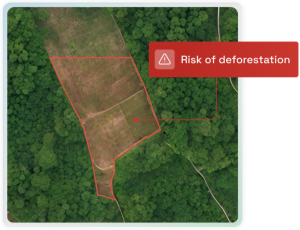
- Each plot is assessed automatically for deforestation using satellite analysis, with legality assessed separately against country and region-specific sources, producing an overall risk score against thresholds you configure.
- Flagged plots trigger a remediation workflow handled in the portal, with every action logged.
- A verified compliance report goes to your buyer, or to other partners in your compliance network, giving them the geodata, risk assessment, and compliance status needed for their own due diligence statement in TRACES.
The supplier portal and support are available in 29 languages, also in Spanish and Portuguese.
What to do before December 30, 2026
- Understand how you are affected: Confirm which of your products fall in scope by CN code, and which deadline applies to each of your EU customers. Annex I was amended in July 2026, so check against the current version.
- Talk to your customers now: Formats and expectations are still settling. Asking what your buyers will need, before they ask you, avoids rework and gives you a say in how the data is exchanged.
- Collect the required data proactively: Plot geolocation, production dates, supplier records, and legality documentation, gathered to one internal standard rather than a separate set per buyer. Collecting it in advance also means gaps are found while there is still time to close them, rather than during a shipment.
- Run risk assessments upfront: Screening your plots for deforestation and legality before a buyer asks leaves time to resolve findings, rather than discovering them when volumes are already committed.
- Build a system that enables you to stand out: A repeatable process that serves any buyer and any shipment is more sustainable than handling each request individually, and it makes you easier to work with as a supplier.
Done properly, this work serves every European customer you supply, not one at a time.
Discover the LATAM EUDR compliance software and see how osapiens HUB for EUDR (Spanish) / osapiens HUB for EUDR (Portuguese) helps exporters turn plot data into buyer-ready evidence, from the first farm onward.