Carbon Footprint Reporting: The Foundation of CSRD Compliance 

Blog
Last edited: February 9, 2026
Read time 5 min.
  • Corporate carbon footprint reporting is becoming a core CSRD requirement.
  • Scope 3 emissions determine whether reporting is complete and credible.
  • Structured processes matter more than perfect data at the start and automation is key to scaling Scope 3 management.
  • osapiens enables audit-ready carbon management across all scopes.

Carbon footprint measurement has become a central element of corporate sustainability reporting. Under the Corporate Sustainability Reporting Directive (CSRD), companies are required to disclose greenhouse gas emissions as part of ESRS E1 – Climate Change. The Corporate Carbon Footprint (CCF) provides the quantitative basis for this disclosure.

Beyond CSRD, carbon data is increasingly linked to broader regulatory and strategic frameworks such as the EU Taxonomy, where emissions transparency supports the assessment of environmentally sustainable economic activities. As a result, carbon emission reporting is no longer a standalone sustainability exercise. It is becoming an integrated compliance and management requirement.

The three emission scopes companies must report on under the GHG Protocol

Corporate carbon footprint reporting follows the Greenhouse Gas (GHG) Protocol

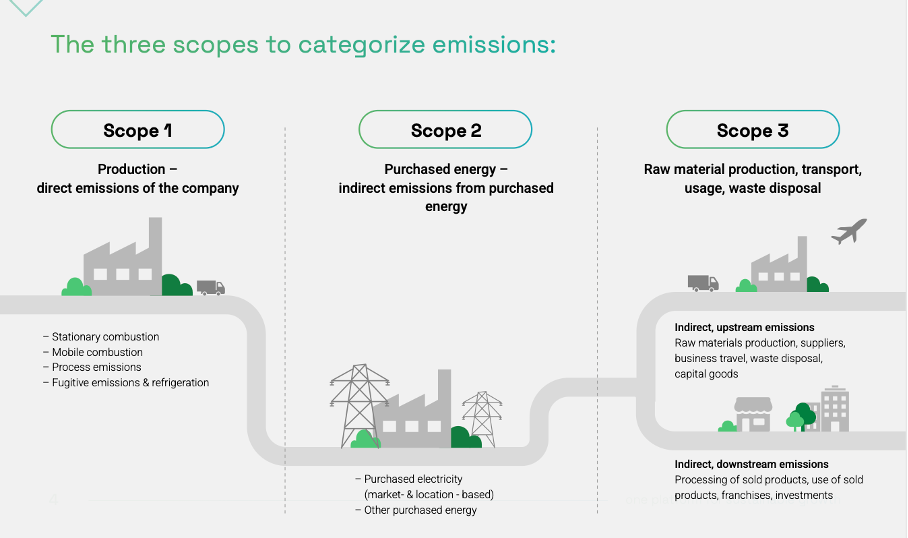
ESRS E1 explicitly refers to the GHG Protocol as the methodological basis for emissions disclosure. As a result, companies are required to report emissions across three defined scopes to ensure completeness and comparability:

Scope 1: Direct emissions from company-owned or controlled sources

Scope 1 covers all direct greenhouse gas emissions from sources that are owned or controlled by the company. These typically include fuel combustion in company vehicles, on-site energy generation, industrial processes, and refrigerant losses. Scope 1 emissions are usually the most straightforward to measure, as the underlying activity data is available internally.

Scope 2: Indirect emissions from purchased energy

Scope 2 includes indirect emissions from purchased energy, such as electricity, steam, heating, or cooling. Although these emissions occur at the energy supplier’s facilities, they are a direct consequence of the company’s energy consumption. For CSRD reporting, Scope 2 emissions must be calculated and disclosed using both the location-based and the market-based method to reflect different procurement and sourcing scenarios.

Scope 3: All other indirect emissions across the value chain

Scope 3 encompasses all other indirect emissions along the value chain, both upstream and downstream. This includes emissions from purchased goods and services, transportation, business travel, waste treatment, product use, and end-of-life processes. Scope 3 often represents the largest share of a company’s total emissions, but it is also the most complex to assess due to its reliance on supplier data, estimates, and external information.

Together, these scopes form the full picture of a company’s climate impact and are the basis for CSRD-compliant disclosure.
Why Scope 3 emissions matter and why they’re often underestimated

Scope 3 emissions typically account for the largest share of total emissions, especially in manufacturing, retail, and asset-light business models. They include emissions from suppliers, transport, product use, and end-of-life treatment.

Despite their relevance, Scope 3 emissions are often underestimated because they sit outside direct operational control. Data availability is limited, methodologies vary, and supplier maturity differs widely. As a result, many companies rely on estimates that meet initial reporting needs but offer limited insight for decision-making.

However, without Scope 3, carbon reporting remains incomplete. This is where regulatory scrutiny, stakeholder expectations, and real decarbonization efforts increasingly converge.

How to get started with Scope 3 emissions reporting

For most companies, Scope 3 is not a calculation problem but a coordination problem. Success depends on structure, prioritization, and scalable supplier collaboration.

Start with a clear internal framework.
Define organizational boundaries, relevant Scope 3 categories, and methodological assumptions early. This ensures consistency and reduces risk under CSRD audit requirements.

osapiens supports this by providing predefined, GHG-Protocol-aligned structures and configurable boundaries that can be documented and reused across reporting cycles.

Prioritize what matters most.
Focus first on emission-intensive categories and key suppliers. Not all Scope 3 data needs the same level of detail at the beginning.

osapiens enables hotspot analysis and category-based prioritization, allowing teams to focus data collection efforts where emissions impact is highest.

Standardize supplier collaboration.
Replace ad hoc questionnaires with structured data requests, clear guidance, and predefined data fields. Automated software lowers effort for suppliers and improves response quality.

osapiens offers standardized, digital supplier data collection workflows that translate complex carbon requirements into manageable, consistent inputs.

Use automation to scale and improve data quality.
Automated workflows enable recurring data collection, validation checks, and gradual replacement of estimates with primary data.

osapiens automates recurring data collection, applies validation and plausibility checks, and supports the gradual replacement of estimates with primary supplier data.

Support suppliers, don’t overwhelm them.
Explain why data is needed, provide context, and share feedback. Simple benchmarks and transparency increase participation.

osapiens provides intuitive interfaces, contextual guidance, and transparent data requirements, lowering barriers for supplier participation.

Ensure traceability from day one.
Document data sources, assumptions, and calculation methods consistently to meet CSRD assurance expectations.

osapiens automatically documents inputs, methodologies, and changes, creating audit-ready traceability across all Scope 3 data.

Scope 3 does not require perfect data at the start. It requires a structured, scalable approach that can mature over time.

How osapiens supports scalable carbon management

The osapiens HUB for CCF enables companies to manage their Corporate Carbon Footprint across all three scopes in one integrated platform. Automated data collection, built-in emission factor databases, and TÜV-certified methodologies support reliable and CSRD-aligned calculations.

By centralizing carbon data and supplier collaboration, osapiens helps companies move from fragmented reporting toward structured, audit-ready emissions management – and creates the foundation for measurable decarbonization over time.

For companies looking to deepen their understanding of CCF calculation and governance, the osapiens guide on how to master Corporate Carbon Footprint Measurement provides practical guidance aligned with CSRD requirements.


  • Corporate carbon footprint reporting is becoming a core CSRD requirement.
  • Scope 3 emissions determine whether reporting is complete and credible.
  • Structured processes matter more than perfect data at the start and automation is key to scaling Scope 3 management.
  • osapiens enables audit-ready carbon management across all scopes.

Carbon footprint measurement has become a central element of corporate sustainability reporting. Under the Corporate Sustainability Reporting Directive (CSRD), companies are required to disclose greenhouse gas emissions as part of ESRS E1 – Climate Change. The Corporate Carbon Footprint (CCF) provides the quantitative basis for this disclosure.

Beyond CSRD, carbon data is increasingly linked to broader regulatory and strategic frameworks such as the EU Taxonomy, where emissions transparency supports the assessment of environmentally sustainable economic activities. As a result, carbon emission reporting is no longer a standalone sustainability exercise. It is becoming an integrated compliance and management requirement.

The three emission scopes companies must report on under the GHG Protocol

Corporate carbon footprint reporting follows the Greenhouse Gas (GHG) Protocol

ESRS E1 explicitly refers to the GHG Protocol as the methodological basis for emissions disclosure. As a result, companies are required to report emissions across three defined scopes to ensure completeness and comparability:

Scope 1: Direct emissions from company-owned or controlled sources

Scope 1 covers all direct greenhouse gas emissions from sources that are owned or controlled by the company. These typically include fuel combustion in company vehicles, on-site energy generation, industrial processes, and refrigerant losses. Scope 1 emissions are usually the most straightforward to measure, as the underlying activity data is available internally.

Scope 2: Indirect emissions from purchased energy

Scope 2 includes indirect emissions from purchased energy, such as electricity, steam, heating, or cooling. Although these emissions occur at the energy supplier’s facilities, they are a direct consequence of the company’s energy consumption. For CSRD reporting, Scope 2 emissions must be calculated and disclosed using both the location-based and the market-based method to reflect different procurement and sourcing scenarios.

Scope 3: All other indirect emissions across the value chain

Scope 3 encompasses all other indirect emissions along the value chain, both upstream and downstream. This includes emissions from purchased goods and services, transportation, business travel, waste treatment, product use, and end-of-life processes. Scope 3 often represents the largest share of a company’s total emissions, but it is also the most complex to assess due to its reliance on supplier data, estimates, and external information.

Together, these scopes form the full picture of a company’s climate impact and are the basis for CSRD-compliant disclosure.

Why Scope 3 emissions matter and why they’re often underestimated

Scope 3 emissions typically account for the largest share of total emissions, especially in manufacturing, retail, and asset-light business models. They include emissions from suppliers, transport, product use, and end-of-life treatment.

Despite their relevance, Scope 3 emissions are often underestimated because they sit outside direct operational control. Data availability is limited, methodologies vary, and supplier maturity differs widely. As a result, many companies rely on estimates that meet initial reporting needs but offer limited insight for decision-making.

However, without Scope 3, carbon reporting remains incomplete. This is where regulatory scrutiny, stakeholder expectations, and real decarbonization efforts increasingly converge.

How to get started with Scope 3 emissions reporting

For most companies, Scope 3 is not a calculation problem but a coordination problem. Success depends on structure, prioritization, and scalable supplier collaboration.

Start with a clear internal framework.
Define organizational boundaries, relevant Scope 3 categories, and methodological assumptions early. This ensures consistency and reduces risk under CSRD audit requirements.

osapiens supports this by providing predefined, GHG-Protocol-aligned structures and configurable boundaries that can be documented and reused across reporting cycles.

Prioritize what matters most.
Focus first on emission-intensive categories and key suppliers. Not all Scope 3 data needs the same level of detail at the beginning.

osapiens enables hotspot analysis and category-based prioritization, allowing teams to focus data collection efforts where emissions impact is highest.

Standardize supplier collaboration.
Replace ad hoc questionnaires with structured data requests, clear guidance, and predefined data fields. Automated software lowers effort for suppliers and improves response quality.

osapiens offers standardized, digital supplier data collection workflows that translate complex carbon requirements into manageable, consistent inputs.

Use automation to scale and improve data quality.
Automated workflows enable recurring data collection, validation checks, and gradual replacement of estimates with primary data.

osapiens automates recurring data collection, applies validation and plausibility checks, and supports the gradual replacement of estimates with primary supplier data.

Support suppliers, don’t overwhelm them.
Explain why data is needed, provide context, and share feedback. Simple benchmarks and transparency increase participation.

osapiens provides intuitive interfaces, contextual guidance, and transparent data requirements, lowering barriers for supplier participation.

Ensure traceability from day one.
Document data sources, assumptions, and calculation methods consistently to meet CSRD assurance expectations.

osapiens automatically documents inputs, methodologies, and changes, creating audit-ready traceability across all Scope 3 data.

Scope 3 does not require perfect data at the start. It requires a structured, scalable approach that can mature over time.

How osapiens supports scalable carbon management

The osapiens HUB for CCF enables companies to manage their Corporate Carbon Footprint across all three scopes in one integrated platform. Automated data collection, built-in emission factor databases, and TÜV-certified methodologies support reliable and CSRD-aligned calculations.

By centralizing carbon data and supplier collaboration, osapiens helps companies move from fragmented reporting toward structured, audit-ready emissions management – and creates the foundation for measurable decarbonization over time.

For companies looking to deepen their understanding of CCF calculation and governance, the osapiens guide on how to master Corporate Carbon Footprint Measurement provides practical guidance aligned with CSRD requirements.