The Most Common Sustainability Reporting Errors — and Their Real Consequences

Blog
Last edited: February 17, 2026
Read time 9 min.
  • Many SMEs underestimate sustainability reporting by treating it as a one-off documentation task rather than a recurring business process. 
  • Typical traps lead to hidden costs – from inefficiencies and errors to lost business opportunities and financing delays. 
  • Frameworks like VSME, supported by digital solutions such as the osapiens HUB, help reduce risk by structuring scope, responsibilities, and outputs. 

Sustainability reporting creates real business value for SMEs – better access to financing, stronger positions in supply chains, and a clearer internal picture of risks and inefficiencies. But that value only materializes when reporting is done consistently. And consistency is exactly where most SMEs run into trouble. 

Not because they lack commitment. But because sustainability reporting tends to enter the business in the worst possible way: reactively, under pressure, and without a clear process behind it. 

The result is a set of recurring traps that look harmless in isolation, but accumulate into real business risk over time. 

The hidden risks of seemingly smart reporting decisions 

Most sustainability reporting problems do not start with a bad decision. They start with a reasonable one. 

An SME receives a questionnaire from a key customer. Someone pulls together what they can, fills it out, and sends it back. Done. Six months later, a bank asks something similar. A slightly different answer goes back. Then another customer asks, and the process repeats. At no point does anyone make a wrong call. Yet over time, this company has created inconsistent data across three stakeholders, no traceable baseline, and no clear owner for any of it. 

This is the pattern. Not negligence – but the slow accumulation of ad hoc decisions that were never meant to become a process. 

Four common reporting traps – and how to get out of them 

Trap 1: Saying yes to everything 

What happens – and why it seems logical  

In an effort to be cooperative, companies try to answer every sustainability question they receive, regardless of relevance or feasibility. Every new customer request adds a few more data points. Every bank inquiry expands the scope a little further. Saying yes avoids friction. Refusing or pushing back on a sustainability question from a key customer feels like the wrong signal to send. 

Why it backfires  

The scope creeps continuously. New data points accumulate without alignment or prioritization. What started as a manageable set of disclosures becomes an expanding list of obligations – most of which were never formally agreed upon. Each reporting cycle demands more effort than the last. There is no stable baseline to build on. And because the scope was never defined, it can never be defended – every incoming request becomes a negotiation. 

The way out  

VSME defines exactly what SMEs are expected to report – and equally importantly, what they are not. That boundary is not arbitrary; it is set by the same body that developed the ESRS standards behind CSRD. Customers and banks increasingly recognize it. That means SMEs gain a legitimate, externally validated basis for managing incoming requests rather than simply absorbing them. With the osapiens HUB, this defined scope becomes the backbone of every stakeholder interaction: one dataset, one clear boundary, no more open-ended negotiations. 

Trap 2: Treating reporting as a one-off task 

What happens – and why it seems logical  

Sustainability data is gathered via spreadsheets, email chains, and individual files – typically in the weeks before a deadline, by whoever happens to be available. For a first request, this is entirely logical. It is low-cost, fast to set up, and requires no investment in tools or processes. 

Why it backfires  

The “one-off” becomes recurring. Manual collection that was designed for a single response gets used again and again, accumulating errors with each cycle. Data is difficult to validate, traceability is poor, and corrections happen under time pressure. Errors go undetected until they matter – in a supplier audit, a financing review, or a tender evaluation. By then, fixing them is far more expensive than preventing them would have been. And with every new reporting cycle, the same fragile process has to be rebuilt from scratch. 

The way out  

A standardized structure means data can be collected once and reused many times. With VSME as a reference and the osapiens HUB as the operational backbone, the next stakeholder request does not trigger a search through old email chains and spreadsheets. It triggers a report that already exists, already validated, already consistent with everything that went before it. What used to take weeks takes an afternoon. 

Trap 3: Assuming shared responsibility is enough 

What happens – and why it seems logical  

Sustainability data collection is distributed across whoever holds the relevant information: finance for energy costs, HR for headcount, operations for emissions. Responsibility is shared – which in practice often means it belongs to no one. Sustainability is genuinely cross-functional, so distributing ownership seems fair and technically sensible. 

Why it backfires  

Without a defined owner, data requests circulate without resolution. Deadlines slip. Gaps appear in disclosures. When something is missing, it is unclear who should have provided it or why it was missed. The immediate cost is internal friction. The longer-term cost is reliability: stakeholders who receive incomplete or inconsistent disclosures once will factor that into how they assess the company the next time. 

The way out  

Structured disclosures make responsibilities concrete. VSME defines a specific set of topics and metrics – which makes it natural to assign a clear owner to each one. Sustainability stops being “everyone’s problem” and becomes a set of specific, manageable tasks distributed across the right people. The osapiens HUB reinforces this through defined workflows: every data point has an owner, a source, and a validation step. Nothing circulates indefinitely. 

Trap 4: Tailoring every answer from scratch 

What happens – and why it seems logical  

Each stakeholder request is treated as unique. Answers are formulated individually, adapted to the specific format or wording of each questionnaire. Different customers and banks ask different questions, so tailoring responses feels respectful and thorough. 

Why it backfires  

The same underlying data point – say, total energy consumption – gets reported differently across three different requests. The numbers do not contradict each other, but they are not directly comparable. Stakeholders who compare notes will notice. Inconsistency erodes credibility in ways that are hard to detect and harder to repair. It also makes every new request more expensive: without a reusable data structure, each questionnaire starts from zero. 

The way out  

A single data structure, maintained centrally and used across all stakeholders, eliminates this risk entirely. The energy figure sent to a customer is the same one that goes to the bank, because it comes from the same validated source. With the osapiens HUB, this consistency is built into the process rather than dependent on individual discipline. Every disclosure draws from the same foundation – which means credibility compounds over time rather than eroding. 

How reporting mistakes can slow or block key business decisions 

The four patterns above rarely cause a single dramatic failure. Their consequences are slower and more insidious: they shape how the company is perceived by the stakeholders who matter most. 

  • A supplier evaluation goes to a competitor whose sustainability data is cleaner and more consistent. 
  • A financing decision is delayed while the bank requests additional clarification on ESG data that should have been straightforward. 
  • A supplier audit has to be repeated because previous disclosures were not traceable to a source. 
  • Sustainability reporting turns into an emergency project the moment a transaction, partnership, or tender requires reliable data quickly. 

None of this results from bad intentions. It results from the absence of structure – and from the compounding effect of decisions that each seemed reasonable at the time. 

VSME reporting: What it is and what it isn’t 

A common misconception is that VSME is simply a lighter version of CSRD – a stripped-down compliance exercise for companies too small to handle the full standard. VSME is a voluntary sustainability reporting standard developed by EFRAG specifically for non-listed SMEs, with a clearly limited scope that reflects the realities of smaller organizations – and a standalone framework in its own right, not a derivative of CSRD. 

That misreading is worth addressing directly, because it leads SMEs in the wrong direction. VSME and CSRD serve different purposes and different audiences. Treating VSME as a watered-down CSRD leads either to over-investing in disclosures that are not necessary, or to underestimating what VSME can do strategically. Understanding the actual relationship between the two frameworks is the starting point for positioning correctly – and for getting the most out of what VSME offers. 

 How osapiens makes sustainability reporting structured, scalable, and stress-free 

The osapiens HUB is built specifically for SMEs that want to move from reactive, ad hoc sustainability reporting to a controlled, repeatable process. It centralizes sustainability data, assigns clear ownership, and makes validated information reusable across customers, banks, and partners. Predefined VSME structures and guided workflows mean that SMEs do not need dedicated sustainability expertise to get started. The platform handles the process; teams handle the decisions. 

As requirements evolve – whether through additional stakeholder demands, a move from the VSME Basic to the Comprehensive Module, or future regulatory alignment – the reporting setup scales without disruption. 

Trusted by more than 2,400 customers worldwide, osapiens combines regulatory expertise with practical implementation experience. For SMEs, that translates into one thing above all: sustainability reporting that is reliable, repeatable, and no longer an emergency. 

Avoiding traps is not about perfection. It is about structure. And structure is what turns sustainability reporting from a recurring problem into a manageable, value-creating process. 

Dive deeper into VSME with the osapiens VSME Guide


  • Many SMEs underestimate sustainability reporting by treating it as a one-off documentation task rather than a recurring business process. 
  • Typical traps lead to hidden costs – from inefficiencies and errors to lost business opportunities and financing delays. 
  • Frameworks like VSME, supported by digital solutions such as the osapiens HUB, help reduce risk by structuring scope, responsibilities, and outputs. 

Sustainability reporting creates real business value for SMEs – better access to financing, stronger positions in supply chains, and a clearer internal picture of risks and inefficiencies. But that value only materializes when reporting is done consistently. And consistency is exactly where most SMEs run into trouble. 

Not because they lack commitment. But because sustainability reporting tends to enter the business in the worst possible way: reactively, under pressure, and without a clear process behind it. 

The result is a set of recurring traps that look harmless in isolation, but accumulate into real business risk over time. 

The hidden risks of seemingly smart reporting decisions 

Most sustainability reporting problems do not start with a bad decision. They start with a reasonable one. 

An SME receives a questionnaire from a key customer. Someone pulls together what they can, fills it out, and sends it back. Done. Six months later, a bank asks something similar. A slightly different answer goes back. Then another customer asks, and the process repeats. At no point does anyone make a wrong call. Yet over time, this company has created inconsistent data across three stakeholders, no traceable baseline, and no clear owner for any of it. 

This is the pattern. Not negligence – but the slow accumulation of ad hoc decisions that were never meant to become a process. 

Four common reporting traps – and how to get out of them 

Trap 1: Saying yes to everything 

What happens – and why it seems logical  

In an effort to be cooperative, companies try to answer every sustainability question they receive, regardless of relevance or feasibility. Every new customer request adds a few more data points. Every bank inquiry expands the scope a little further. Saying yes avoids friction. Refusing or pushing back on a sustainability question from a key customer feels like the wrong signal to send. 

Why it backfires  

The scope creeps continuously. New data points accumulate without alignment or prioritization. What started as a manageable set of disclosures becomes an expanding list of obligations – most of which were never formally agreed upon. Each reporting cycle demands more effort than the last. There is no stable baseline to build on. And because the scope was never defined, it can never be defended – every incoming request becomes a negotiation. 

The way out  

VSME defines exactly what SMEs are expected to report – and equally importantly, what they are not. That boundary is not arbitrary; it is set by the same body that developed the ESRS standards behind CSRD. Customers and banks increasingly recognize it. That means SMEs gain a legitimate, externally validated basis for managing incoming requests rather than simply absorbing them. With the osapiens HUB, this defined scope becomes the backbone of every stakeholder interaction: one dataset, one clear boundary, no more open-ended negotiations. 

Trap 2: Treating reporting as a one-off task 

What happens – and why it seems logical  

Sustainability data is gathered via spreadsheets, email chains, and individual files – typically in the weeks before a deadline, by whoever happens to be available. For a first request, this is entirely logical. It is low-cost, fast to set up, and requires no investment in tools or processes. 

Why it backfires  

The “one-off” becomes recurring. Manual collection that was designed for a single response gets used again and again, accumulating errors with each cycle. Data is difficult to validate, traceability is poor, and corrections happen under time pressure. Errors go undetected until they matter – in a supplier audit, a financing review, or a tender evaluation. By then, fixing them is far more expensive than preventing them would have been. And with every new reporting cycle, the same fragile process has to be rebuilt from scratch. 

The way out  

A standardized structure means data can be collected once and reused many times. With VSME as a reference and the osapiens HUB as the operational backbone, the next stakeholder request does not trigger a search through old email chains and spreadsheets. It triggers a report that already exists, already validated, already consistent with everything that went before it. What used to take weeks takes an afternoon. 

Trap 3: Assuming shared responsibility is enough 

What happens – and why it seems logical  

Sustainability data collection is distributed across whoever holds the relevant information: finance for energy costs, HR for headcount, operations for emissions. Responsibility is shared – which in practice often means it belongs to no one. Sustainability is genuinely cross-functional, so distributing ownership seems fair and technically sensible. 

Why it backfires  

Without a defined owner, data requests circulate without resolution. Deadlines slip. Gaps appear in disclosures. When something is missing, it is unclear who should have provided it or why it was missed. The immediate cost is internal friction. The longer-term cost is reliability: stakeholders who receive incomplete or inconsistent disclosures once will factor that into how they assess the company the next time. 

The way out  

Structured disclosures make responsibilities concrete. VSME defines a specific set of topics and metrics – which makes it natural to assign a clear owner to each one. Sustainability stops being “everyone’s problem” and becomes a set of specific, manageable tasks distributed across the right people. The osapiens HUB reinforces this through defined workflows: every data point has an owner, a source, and a validation step. Nothing circulates indefinitely. 

Trap 4: Tailoring every answer from scratch 

What happens – and why it seems logical  

Each stakeholder request is treated as unique. Answers are formulated individually, adapted to the specific format or wording of each questionnaire. Different customers and banks ask different questions, so tailoring responses feels respectful and thorough. 

Why it backfires  

The same underlying data point – say, total energy consumption – gets reported differently across three different requests. The numbers do not contradict each other, but they are not directly comparable. Stakeholders who compare notes will notice. Inconsistency erodes credibility in ways that are hard to detect and harder to repair. It also makes every new request more expensive: without a reusable data structure, each questionnaire starts from zero. 

The way out  

A single data structure, maintained centrally and used across all stakeholders, eliminates this risk entirely. The energy figure sent to a customer is the same one that goes to the bank, because it comes from the same validated source. With the osapiens HUB, this consistency is built into the process rather than dependent on individual discipline. Every disclosure draws from the same foundation – which means credibility compounds over time rather than eroding. 

How reporting mistakes can slow or block key business decisions 

The four patterns above rarely cause a single dramatic failure. Their consequences are slower and more insidious: they shape how the company is perceived by the stakeholders who matter most. 

  • A supplier evaluation goes to a competitor whose sustainability data is cleaner and more consistent. 
  • A financing decision is delayed while the bank requests additional clarification on ESG data that should have been straightforward. 
  • A supplier audit has to be repeated because previous disclosures were not traceable to a source. 
  • Sustainability reporting turns into an emergency project the moment a transaction, partnership, or tender requires reliable data quickly. 

None of this results from bad intentions. It results from the absence of structure – and from the compounding effect of decisions that each seemed reasonable at the time. 

VSME reporting: What it is and what it isn’t 

A common misconception is that VSME is simply a lighter version of CSRD – a stripped-down compliance exercise for companies too small to handle the full standard. VSME is a voluntary sustainability reporting standard developed by EFRAG specifically for non-listed SMEs, with a clearly limited scope that reflects the realities of smaller organizations – and a standalone framework in its own right, not a derivative of CSRD. 

That misreading is worth addressing directly, because it leads SMEs in the wrong direction. VSME and CSRD serve different purposes and different audiences. Treating VSME as a watered-down CSRD leads either to over-investing in disclosures that are not necessary, or to underestimating what VSME can do strategically. Understanding the actual relationship between the two frameworks is the starting point for positioning correctly – and for getting the most out of what VSME offers. 

 How osapiens makes sustainability reporting structured, scalable, and stress-free 

The osapiens HUB is built specifically for SMEs that want to move from reactive, ad hoc sustainability reporting to a controlled, repeatable process. It centralizes sustainability data, assigns clear ownership, and makes validated information reusable across customers, banks, and partners. Predefined VSME structures and guided workflows mean that SMEs do not need dedicated sustainability expertise to get started. The platform handles the process; teams handle the decisions. 

As requirements evolve – whether through additional stakeholder demands, a move from the VSME Basic to the Comprehensive Module, or future regulatory alignment – the reporting setup scales without disruption. 

Trusted by more than 2,400 customers worldwide, osapiens combines regulatory expertise with practical implementation experience. For SMEs, that translates into one thing above all: sustainability reporting that is reliable, repeatable, and no longer an emergency. 

Avoiding traps is not about perfection. It is about structure. And structure is what turns sustainability reporting from a recurring problem into a manageable, value-creating process. 

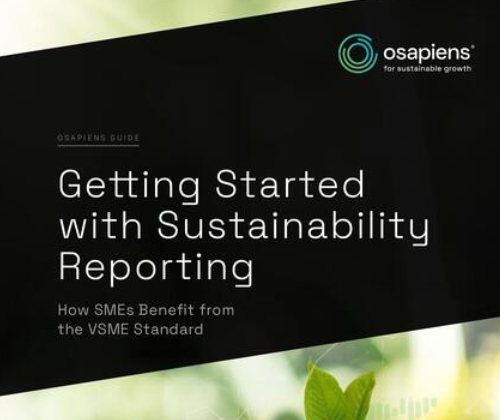
Dive deeper into VSME with the osapiens VSME Guide