Community
osapeers.org
This article is available in
About this article

Hardik Agrawal
AuthorAssigned categories
PFAS, or per- and polyfluoroalkyl substances, have become one of the most pressing regulatory topics affecting product compliance and supply chains across the European Union. Once a niche concern, PFAS regulations now impact businesses in nearly every sector, from textiles and packaging to electronics and manufacturing.
For compliance managers, the challenge is clear: PFAS restrictions are expanding rapidly, and companies must understand where these substances appear in their products and how to demonstrate compliance across multiple regulatory frameworks.
PFAS are a large group of synthetic chemicals characterized by strong carbon-fluorine bonds. This molecular structure makes them extremely resistant to heat, water, grease, and degradation (properties that have made them valuable across industries for decades).
Common applications include:
However, this same stability creates a significant problem. PFAS degrade extremely slowly in the environment, persisting in soil, groundwater, and ecosystems for extended periods. This has earned them the nickname “forever chemicals.”
Research shows that certain PFAS can accumulate in living organisms and have been linked to health concerns, including immune system effects and changes in cholesterol levels. Contamination has been detected in drinking water, soil, and food across Europe and beyond. Cleanup efforts are technically complex and costly, driving regulators to take increasingly stringent action.
The European Union regulates PFAS through multiple legal frameworks rather than a single law. This means companies must navigate compliance requirements across several regulations, each with different scopes and timelines.
Key regulations include:
A broad “universal PFAS restriction” proposal submitted by Germany, Denmark, the Netherlands, Norway, and Sweden aims to phase out most PFAS uses unless deemed essential and lacking alternatives. While still under review, this proposal signals the long-term regulatory direction.
Curious about how PPWR impacts PFAS usage in packaging? Learn more in our PPWR compliance guide.
The biggest compliance challenge isn’t just understanding the regulations. It’s achieving transparency across global supply chains.
PFAS can enter products at multiple production stages. They may be present in raw materials, surface coatings, additives, or processing aids that suppliers don’t always fully document. This creates several obstacles:
For compliance managers, this means traditional data collection methods (spreadsheets, supplier questionnaires, and manual tracking) are no longer sufficient to maintain oversight.
While PFAS regulations are still evolving, the trajectory is clear: restrictions will expand, monitoring requirements will increase, and companies will need to demonstrate transparency throughout the product lifecycle.
osapiens HUB for Product Compliance is a centralized platform designed to automate product compliance management across your organization and supplier network. It supports compliance with PFAS, REACH, RoHS, PPWR, the EU Battery Regulation, and other frameworks, and can be adapted to your specific needs, regardless of your company’s size.
Companies that begin mapping their product portfolios, identifying potential PFAS exposure, and improving supplier data collection now will be better positioned as new restrictions take effect.
Understanding where PFAS may appear in your products, how EU regulations apply, and what compliance steps are required can be complex.
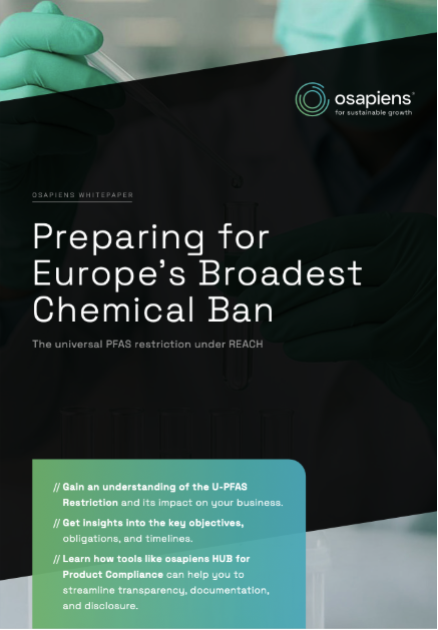
The osapiens PFAS guide provides a comprehensive overview of the regulatory landscape, affected industries, and practical strategies for managing PFAS compliance across the supply chain.