PPWR: Roles and Responsibilities Across the Supply Chain

Blog
Last edited: January 14, 2026
Read time 6 min.

One of the biggest changes in the Packaging and Packaging Waste Regulation (PPWR) is not a rule about materials or recyclability. It is the way the regulation assigns responsibility. The PPWR makes it clear that:

  • Different actors in the supply chain have different duties. 
  • Each company must know exactly which role it plays for each product. 

For many businesses, this is the hardest part of PPWR. It requires companies to assess every packaged item and define their role with precision. Getting this wrong can lead to missing obligations, incomplete documentation, or delays in placing products on the EU market.

PPWR Roles Explained: Who is Responsible for Packaging in the EU

PPWR uses four main roles to describe who is responsible for what, when packaging is placed on the EU market. These roles are simple in theory but complex in practice: a single company can hold different roles depending on the product.

Producers

A producer is the company that puts packaging on the EU market under its own name or brand. This includes businesses that design or commission packaging for their own products.

Example: A supermarket launches a private-label line of pasta. Even though an external supplier makes the packaging, the supermarket is the producer because its brand appears on the package.

Manufacturers

A manufacturer is the company that physically produces the packaging. They create the packaging material or component, even if someone else sells it.

Example: A packaging company produces cardboard boxes for several brands. It does not sell the products inside the boxes, but as the producer of the packaging itself, it is the manufacturer.

Importers

An importer brings packaged goods from outside the EU into an EU Member State. The importer becomes responsible for ensuring that the packaging meets PPWR rules before it enters the EU market.

Example: A European electronics retailer buys headphones from a supplier in China. When the goods arrive in the EU, the retailer becomes the importer and is responsible for ensuring the packaging meets PPWR rules.

Distributors

A distributor offers packaged goods within the EU but does not produce or import the packaging. They must make sure the packaging they sell is compliant and properly labeled.

Example: A wholesaler buys packaged food products from a producer in France and sells them to stores in Germany. The wholesaler is a distributor, because it moves the product within the EU but does not brand, design, or import the packaging.

Why incorrect PPWR role classification is a major compliance risk 

These roles may overlap. A retailer with private-label products may be a producer for some items, a distributor for others, and an importer for all goods sourced outside the EU. This is why the PPWR pushes companies to classify each product individually. 

Misclassification leads to misaligned compliance efforts. The PPWR assigns different duties to each role, such as: 

  • collecting and sharing packaging data 
  • ensuring packaging meets design and material rules 
  • providing information to other actors in the supply chain 
  • ensuring labeling and documentation are correct 
  • making required declarations when placing packaging on the market 

Incorrect classification creates gaps that regulators can easily detect. It also complicates cooperation within the supply chain because responsibilities are unclear.

PPWR Guide: How to determine your role

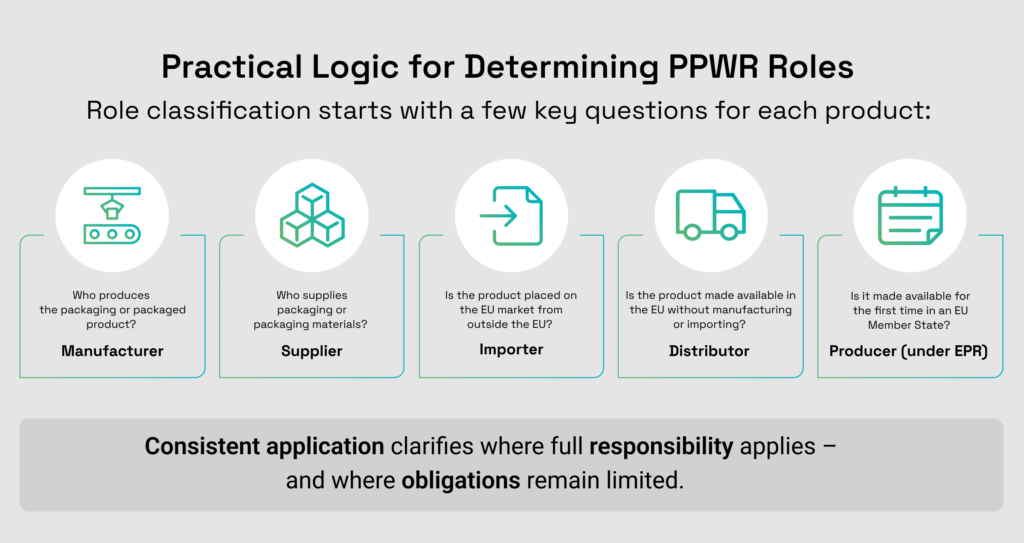
The most effective way to classify roles under the PPWR is to ask clear questions for each product: 

  1. Whose name or brand appears on the packaging?
    If it is yours, you are the producer, even if the packaging was made by a third party.
  1. Who physically manufactures the packaging?
    This determines the manufacturer, but producers remain responsible when their own brand is used.
  1. Is the product imported from outside the EU?
    If yes, the company that brings it into the EU is the importer, no matter who designed the packaging.
  1. Is the company only passing on packaged goods within the EU?
    If yes, the company acts as a distributor

Applying this logic consistently helps companies understand where they carry full responsibility and where their role is more limited. Many businesses will find that their responsibilities vary across product lines, regions, and sourcing models.

PPWR Roles in practice: real-world supply chain Example

Example 1: Private-label retail

A supermarket chain sells its own-label pasta. 

  • The supermarket is the producer because its brand appears on the packaging. 
  • The packaging supplier is the manufacturer
  • If the pasta is sourced from outside the EU, the supermarket is also the importer

This means the retailer carries most of the compliance duties. If the same supermarket sells branded pasta from another label, it is usually a distributor – unless it imports the goods from outside the EU or repacks them, in which case it becomes the importer (and/or producer of the packaging). 

Example 2: E-commerce marketplace

An online marketplace ships products stored in its warehouse. 

  • If the platform repacks goods in its own packaging or branded materials, it becomes the producer of that packaging. 
  • If it only sells third-party goods from and within the EU, it acts as a distributor
  • If it only sells third-party goods from outside the EU, it acts as an importer

Example 3: Global sourcing

A company buys packaged electronics from a supplier in Asia. 

  • The EU-based company is the importer, even if the packaging design was done abroad. 
  • The company must ensure the packaging meets PPWR obligations before it enters the EU. 

These examples show why each product must be assessed individually – wrong assumptions lead to compliance errors under the PPWR. 

Managing PPWR Roles Across the Supply Chain with the osapiens HUB for Product Compliance

The PPWR makes it challenging to keep track of roles and responsibilities, especially when products come from many sources. The osapiens HUB for Product Compliance simplifies this process significantly. It guides teams through each step, puts all role information in one place, and shows exactly what is required for every product. With clear workflows and connected data, companies can handle complex PPWR tasks with confidence and stay compliant across the entire supply chain. 

Want to dive deeper into the topic? Download the osapiens PPWR Guide now.


One of the biggest changes in the Packaging and Packaging Waste Regulation (PPWR) is not a rule about materials or recyclability. It is the way the regulation assigns responsibility. The PPWR makes it clear that:

  • Different actors in the supply chain have different duties. 
  • Each company must know exactly which role it plays for each product. 

For many businesses, this is the hardest part of PPWR. It requires companies to assess every packaged item and define their role with precision. Getting this wrong can lead to missing obligations, incomplete documentation, or delays in placing products on the EU market.

PPWR Roles Explained: Who is Responsible for Packaging in the EU

PPWR uses four main roles to describe who is responsible for what, when packaging is placed on the EU market. These roles are simple in theory but complex in practice: a single company can hold different roles depending on the product.

Producers

A producer is the company that puts packaging on the EU market under its own name or brand. This includes businesses that design or commission packaging for their own products.

Example: A supermarket launches a private-label line of pasta. Even though an external supplier makes the packaging, the supermarket is the producer because its brand appears on the package.

Manufacturers

A manufacturer is the company that physically produces the packaging. They create the packaging material or component, even if someone else sells it.

Example: A packaging company produces cardboard boxes for several brands. It does not sell the products inside the boxes, but as the producer of the packaging itself, it is the manufacturer.

Importers

An importer brings packaged goods from outside the EU into an EU Member State. The importer becomes responsible for ensuring that the packaging meets PPWR rules before it enters the EU market.

Example: A European electronics retailer buys headphones from a supplier in China. When the goods arrive in the EU, the retailer becomes the importer and is responsible for ensuring the packaging meets PPWR rules.

Distributors

A distributor offers packaged goods within the EU but does not produce or import the packaging. They must make sure the packaging they sell is compliant and properly labeled.

Example: A wholesaler buys packaged food products from a producer in France and sells them to stores in Germany. The wholesaler is a distributor, because it moves the product within the EU but does not brand, design, or import the packaging.

Why incorrect PPWR role classification is a major compliance risk 

These roles may overlap. A retailer with private-label products may be a producer for some items, a distributor for others, and an importer for all goods sourced outside the EU. This is why the PPWR pushes companies to classify each product individually. 

Misclassification leads to misaligned compliance efforts. The PPWR assigns different duties to each role, such as: 

  • collecting and sharing packaging data 
  • ensuring packaging meets design and material rules 
  • providing information to other actors in the supply chain 
  • ensuring labeling and documentation are correct 
  • making required declarations when placing packaging on the market 

Incorrect classification creates gaps that regulators can easily detect. It also complicates cooperation within the supply chain because responsibilities are unclear.

PPWR Guide: How to determine your role

The most effective way to classify roles under the PPWR is to ask clear questions for each product: 

  1. Whose name or brand appears on the packaging?
    If it is yours, you are the producer, even if the packaging was made by a third party.
  1. Who physically manufactures the packaging?
    This determines the manufacturer, but producers remain responsible when their own brand is used.
  1. Is the product imported from outside the EU?
    If yes, the company that brings it into the EU is the importer, no matter who designed the packaging.
  1. Is the company only passing on packaged goods within the EU?
    If yes, the company acts as a distributor

Applying this logic consistently helps companies understand where they carry full responsibility and where their role is more limited. Many businesses will find that their responsibilities vary across product lines, regions, and sourcing models.

PPWR Roles in practice: real-world supply chain Example

Example 1: Private-label retail

A supermarket chain sells its own-label pasta. 

  • The supermarket is the producer because its brand appears on the packaging. 
  • The packaging supplier is the manufacturer
  • If the pasta is sourced from outside the EU, the supermarket is also the importer

This means the retailer carries most of the compliance duties. If the same supermarket sells branded pasta from another label, it is usually a distributor – unless it imports the goods from outside the EU or repacks them, in which case it becomes the importer (and/or producer of the packaging). 

Example 2: E-commerce marketplace

An online marketplace ships products stored in its warehouse. 

  • If the platform repacks goods in its own packaging or branded materials, it becomes the producer of that packaging. 
  • If it only sells third-party goods from and within the EU, it acts as a distributor
  • If it only sells third-party goods from outside the EU, it acts as an importer

Example 3: Global sourcing

A company buys packaged electronics from a supplier in Asia. 

  • The EU-based company is the importer, even if the packaging design was done abroad. 
  • The company must ensure the packaging meets PPWR obligations before it enters the EU. 

These examples show why each product must be assessed individually – wrong assumptions lead to compliance errors under the PPWR. 

Managing PPWR Roles Across the Supply Chain with the osapiens HUB for Product Compliance

The PPWR makes it challenging to keep track of roles and responsibilities, especially when products come from many sources. The osapiens HUB for Product Compliance simplifies this process significantly. It guides teams through each step, puts all role information in one place, and shows exactly what is required for every product. With clear workflows and connected data, companies can handle complex PPWR tasks with confidence and stay compliant across the entire supply chain. 

Want to dive deeper into the topic? Download the osapiens PPWR Guide now.


About osapiens

osapiens – one platform for sustainable growth
osapiens develops software that empowers companies to drive sustainable growth across their entire value chain.

The osapiens HUB, a multi-tenant hyperscaler platform designed to enable cross-company collaboration and AI-automation, combines over 25 solutions in two categories: Transparency solutions enable companies to report on financial and non-financial data, manage supply chains, mitigate risk of all kinds (including cyber-risks and trade- and geo-political risks), and ensure compliance with product, reporting and supply chain regulations. Efficiency solutions enable AI-driven supplier collaboration, maintenance, service, and distribution processes to improve operational performance and strengthen competitiveness.

osapiens supports more than 2,400 customers worldwide, from SMEs to global enterprises across industries. Headquartered in Mannheim, Germany, with offices across Europe and the United States, the company works with an international team of over 550 employees.

Christian Feuring

External Communications Manager