Community
osapeers.org
This article is available in
About this article

Jessica Hollfelder
AuthorAssigned categories
The Omnibus I simplification package has reshaped the European sustainability reporting landscape. Reporting obligations have been reduced, timelines adjusted, and scope narrowed. For companies that are now descoped from sustainability reporting obligations this has triggered an understandable question: Is sustainability reporting still relevant?
The answer is yes, but for different reasons than before. While regulatory pressure has eased for parts of the market, expectations from investors, business partners, and boards remain high. Sustainability reporting is no longer primarily about meeting a legal threshold. It is increasingly about creating clarity, supporting decision-making, and strengthening long-term resilience.
The Sustainability Omnibus package was introduced to simplify the European sustainability regulatory framework and reduce complexity for companies. In practice, it led to several concrete changes that directly affect sustainability reporting obligations.
In December 2025, the European Parliament formally adopted the final Omnibus I text in line with the provisional agreement reached with the Council of the European Union. The Council is expected to give its formal approval in early 2026.
The key decisions affect three key sustainability regulations and their timeline as follows:
Overall, the Omnibus aims to reduce regulatory complexity and reporting burden, while leaving core expectations around transparency, sustainability risk management, and decision-useful data largely unchanged.
What is important to understand, however, is what the Omnibus did not change. Investor expectations, partner requirements, financing conditions, and board-level demands for reliable sustainability data remain firmly in place. The need for comparable, and decision-relevant information is steadily increasing.
With reduced regulatory pressure, sustainability reporting becomes a strategic decision rather than a purely compliance-driven task. Companies now have greater flexibility in deciding how they report and greater possibilities to use reporting as a strategic lever.
For many organizations, reporting is shifting closer to finance, risk management, and corporate strategy. Sustainability data is increasingly used to assess transition risks and support informed investment decisions. In this context, reporting evolves from an external disclosure exercise into an internal management capability.
The Omnibus also changes the framework landscape. While ESRS remains relevant for companies still in scope, others are exploring alternatives such as ISSB, VSME or selected voluntary standards to ensure international comparability and decision-useful reporting.
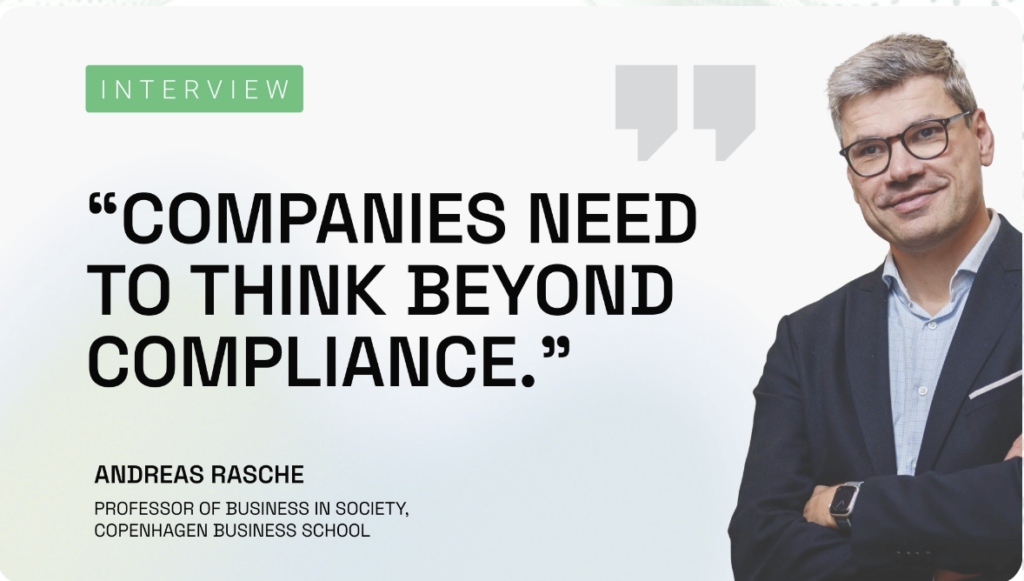
Professor Andreas Rasche from Copenhagen Business School is one of Europe’s leading academic voices on corporate sustainability, ESG, and regulation. His work connects academic research with corporate practice and public policy, with a strong focus on sustainability governance and sustainable finance.
In his assessment of the Omnibus, Rasche emphasizes that regulatory simplification does not reduce the strategic relevance of sustainability. As he puts it:
“Sustainability is not about compliance, but about long-term resilience and competitiveness.”
In a dedicated interview, Andreas Rasche explores what the Omnibus outcome means for companies in practice. He explains why many organizations continue structured sustainability reporting despite reduced obligations. Read also about how reporting supports trust and predictability, and why sustainability data is becoming more closely linked to finance and risk management. The interview looks ahead, examining how reporting frameworks may evolve and what strategic choices companies face.
Read now: “Sustainability is a strategic priority, not a reporting exercise”
The Omnibus marks a turning point for sustainability reporting in Europe. As regulatory requirements change, companies are reassessing how reporting supports resilience, governance, and long-term positioning.
These questions will be explored in more depth in the upcoming live webinar “Sustainability Reporting after the Omnibus” with Andreas Rasche and osapiens experts. The discussion is based on a new European study with insights from 400 companies and focuses on what stays relevant after the Omnibus, how organizations choose between ESRS, ISSB, and voluntary standards, and what this means for risk management and strategic decision-making.
The webinar takes place on February 24, 2026, at 13:00 CET and is the right starting point for sustainability and ESG leaders, as well as strategy, risk, finance, reporting, and compliance professionals.