Community
osapeers.org
This article is available in
About this article

Di Liao
AuthorAssigned categories
The EU’s Omnibus I package has altered the sustainability reporting landscape in Europe. For some organizations, reporting obligations under CSRD have been eased. Thresholds have been adjusted and timelines recalibrated, removing parts of the reporting population from immediate scope.
Yet one question remains unresolved: How can sustainability reporting be sustained and justified when CSRD compliance is no longer required?
The osapiens report Beyond Compliance: Sustainability Reporting After the Omnibus addresses this directly. Surveying over 400 senior decision-makers across the EU and UK, it examines organizational responses to Omnibus I and what makes sustainability reporting durable beyond regulation. The finding: 90% will continue reporting – but the business case has fundamentally shifted.
The Omnibus I package was introduced to reduce regulatory complexity and balance reporting requirements across sustainability regulations. However, the findings from our latest survey indicate that how sustainability information is used to evaluate risk by markets, partners, and decision-makers has not changed.
Sustainability risks continue to be considered financially material, and the expectation for structured, credible disclosure persists across capital markets, value chains, and business relationships. Even where formal reporting obligations have changed, the demand for reliable sustainability data remains strong.
As Andreas Rasche, Professor and Associate Dean at Copenhagen Business School, explains:
“The Omnibus has changed how sustainability reporting obligations apply, but it has not necessarily removed the underlying rationale for reporting. Stakeholder expectations for sustainability reporting still exist – from business partners, investors, banks, and from society more broadly.”
For companies, this creates a more confronting decision environment. Sustainability reporting can no longer be justified by regulatory obligation alone; its role and value must be clearly anchored within competing business priorities.
>> For a detailed breakdown of what Omnibus I changed, and what it didn’t, see our overview on sustainability reporting after the Omnibus here.
Despite the reduction in regulatory pressure, the survey results clearly show a preference for continuity in sustainability reporting. This directly contradicts the expectation of a post-Omnibus pullback in reporting activity.
According to the osapiens survey:
These results suggest that sustainability reporting has moved beyond a narrow compliance function. For many organizations, reporting is no longer treated as a standalone exercise, but as part of broader planning, governance, and management processes.
As Rasche observes:
“The results show a clear preference for reporting continuity, even as policy shifts have caused uncertainty. This reflects the fact that many organizations have already embedded sustainability reporting into planning, governance, and internal decision-making.”
Continuity of reporting intent and activity, however, does not imply that reporting capabilities are protected from future resourcing, prioritization, or governance pressures – a gap that becomes critical over time.
One of the report’s most critical findings is the growing gap between intention and resourcing.
While most organizations plan to continue reporting, 84% expect reduced regulatory scrutiny to result in fewer resources being allocated to sustainability reporting over time. Budget constraints, fragmented data landscapes, and unclear ownership already pose challenges, and these risks increase when reporting is no longer externally enforced. This creates what the report describes as a “sustainability paradox”: reporting remains valuable, but increasingly fragile.
Rasche is explicit about the implications. If firms can no longer rely on compliance alone to justify sustainability reporting, “they must really consider the purpose of voluntary action and decide what role sustainability reporting plays in how they run the business”.
In other words, without a defined internal business case, sustainability reporting is likely to be deprioritized and stripped of dedicated resources over time – even if its importance is widely acknowledged.
One reason many organizations hesitate to roll back reporting is that sustainability data is already used far beyond formal disclosures. The survey shows it plays a key role in:
Nearly half of respondents identify improved visibility into operational, climate, and supply-chain risks as the greatest benefit of sustainability reporting.
Once sustainability data becomes embedded in high-impact decisions, removing it introduces blind spots into planning, risk assessment, and investment decisions. At that point, sustainability reporting functions as decision infrastructure, and scaling it back affects decision quality with tangible operational and financial consequences.
Post-Omnibus, organizations are not stepping away from structured sustainability reporting. Survey results show continued alignment with established reporting frameworks, even where formal CSRD obligations no longer apply.
Among respondents:
These figures demonstrate that organizations continue to rely on structured reporting frameworks rather than ad hoc disclosure. For organizations not yet subject to the CSRD, or lacking the resources to implement full CSRD-aligned reporting, the VSME provides a scalable entry point for structured sustainability reporting (explained in detail here).
The Omnibus has shifted responsibility inward. Organizations now have to decide:
Access the full report and webinar recording
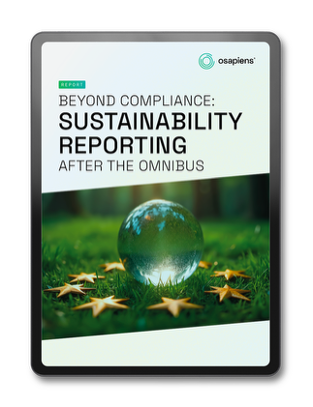
The complete report Beyond Compliance: Sustainability Reporting After the Omnibus includes:
The findings have also been discussed in a webinar featuring Andreas Rasche and osapiens leadership, exploring what the Omnibus means in practice for the future of sustainability reporting.
>> Streamline your sustainability reporting with osapiens: discover how the osapiens HUB Reporting Cockpit consolidates sustainability KPIs across multiple frameworks into a single, audit-ready platform.