swissdamed Explained: Requirements, Deadlines, and What Medical Device Companies Should Do Now

Blog
Last edited: January 28, 2026
Read time 7 min.

swissdamed (Swiss Database on Medical Devices) is Swissmedic’s national database for medical devices in Switzerland. It is used to register economic operators and medical devices that are placed on the Swiss market, including in vitro diagnostic medical devices (IVDs). The goal is to make key information easier to find and to support transparency, traceability, and regulatory oversight.

swissdamed also includes a public website with search functions. This lets users look up medical devices available in Switzerland and see which companies are responsible for them, such as manufacturers, authorized representatives, and importers.

Why was swissdamed created?

swissdamed was created after a major regulatory change in May 2021. When the Mutual Recognition Agreement (MRA) between Switzerland and the EU ended, Switzerland could no longer rely on automatic recognition of EU medical device approvals. Switzerland therefore had to adapt its approach to keep safety standards aligned with the EU while using its own national system.

In this context, swissdamed was developed as Switzerland’s counterpart to EUDAMED, the European database. It supports Switzerland’s regulatory oversight while staying compatible with EU systems where needed.
swissdamed: key objectives and purpose 

swissdamed was designed to bring structure and clarity to the Swiss medical device landscape.  

  • At its core, the database centralizes information that was previously spread across different systems and documents. Medical devices and the companies responsible for them are now recorded in one national source, managed by Swissmedic
  • Another key objective is transparency. swissdamed makes selected device and operator information publicly searchable. This helps healthcare professionals, patients, and authorities understand which devices are available in Switzerland and who is legally responsible for them. Clear visibility reduces uncertainty and supports trust in the market. 
  • swissdamed also plays an important role in market surveillance. By collecting structured and standardized data, the database supports post-market monitoring and incident management. Authorities can react more efficiently to safety issues, while economic operators benefit from clearer reporting pathways. 
  • Finally, swissdamed supports regulatory equivalence with the European Union. While Switzerland operates its own system, the database is closely aligned with EU requirements. This helps reduce friction for companies active in both markets and supports cross-border trade without lowering safety standards. 

Modular architecture of swissdamed

swissdamed follows a modular structure. This means that different types of data are handled in dedicated modules rather than one large system. The approach mirrors the structure of EUDAMED and is intended to limit additional workload for economic operators already familiar with EU processes. Learn more about the structure of EUDAMED and its specific requirements within this blog

At present, swissdamed consists of two main modules: the Actors module and the Devices module. 

Actors Module: registering economic operators

The Actors module went live on August 6, 2024, and it focuses on the registration of economic operators established in Switzerland or Liechtenstein. This includes Swiss or Liechtenstein manufacturers, Swiss authorized representatives acting for foreign manufacturers, and importers based in Switzerland or Liechtenstein. Each operator must register before placing devices on the Swiss market. 

Once Swissmedic approves the registration, the operator receives a CHRN (Swiss Single Registration Number). This number serves as a unique identifier and is used across regulatory processes. In practice, the CHRN plays a similar role to the SRN used in the EU, helping authorities clearly identify responsible actors. 

Devices Module: medical device and IVD registration

The Devices module, also referred to as the UDI module, has been available since August 2025. It is used to register medical devices, in vitro diagnostic medical devices, systems, and procedure packs placed on the Swiss market. 

At this stage, device registration is performed via XML file uploads. This approach allows companies to reuse existing data with minimal changes. Looking ahead, Swissmedic plans to introduce machine-to-machine (M2M) interfaces. These will allow automated data exchange and further reduce manual effort for economic operators managing large device portfolios. 
Who must register in swissdamed? 

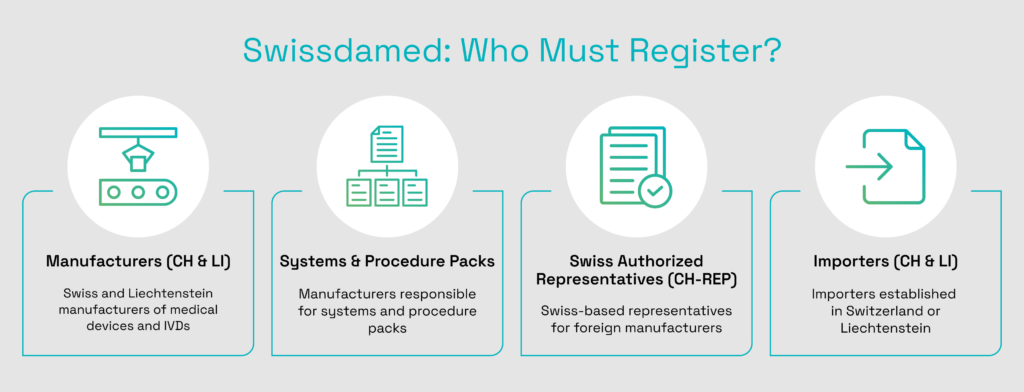
Registration in swissdamed is mandatory for the following economic operators involved in placing medical devices on the Swiss market: 

  • Swiss and Liechtenstein manufacturers of medical devices and IVDs 
    Any manufacturer established in Switzerland or Liechtenstein that produces medical devices or in vitro diagnostic medical devices must register. This applies regardless of device risk class and covers devices intended to be made available on the Swiss market. 
  • Manufacturers of systems and procedure packs 
    Companies that combine multiple medical devices into systems or procedure packs and place them on the market under their own responsibility must also register. These products require clear traceability to a responsible economic operator. 
  • Swiss authorized representatives (CH-REP) 
    Swiss-based authorized representatives appointed by foreign manufacturers must register in swissdamed. The CH-REP acts as the local regulatory contact for Swissmedic and plays a key role in compliance, market surveillance, and incident handling. 
  • Importers established in Switzerland or Liechtenstein 
    Importers that bring medical devices or IVDs into Switzerland or Liechtenstein are required to register. Their role in the supply chain makes them a critical point of contact for traceability and regulatory oversight. 

With the osapiens HUB for Medical Devices, you can syndicate validated product data, automate UDI submissions for swissdamed and other global systems (EUDAMED, GUDID, COVIN, and more), and stay deadline-ready with confidence. 

swissdamed and EUDAMED: the key differences

swissdamed is closely aligned with the EU’s EUDAMED database, but the two systems are not interchangeable. They are separate regulatory obligations, and companies placing devices on both markets must treat them independently. 

Geographic scope and authority

EUDAMED serves the EU and EEA and is managed by the European Commission. swissdamed is Switzerland’s national database, also covering Liechtenstein, and is operated by Swissmedic as the competent authority. 

Modules and functional coverage

EUDAMED is built around six modules, covering actors, devices, certificates and notified bodies, clinical investigations, vigilance, and market surveillance. We dive deeper into these modules in our guide to successful EUDAMED implementation. swissdamed currently focuses on a narrower scope, with the Actors module and the UDI Devices module forming the core of operator and device registration. Further functionality is planned but does not mirror all EU modules.

Registration responsibilities

In EUDAMED, EU manufacturers, authorized representatives, and importers register for the EU market and receive an SRN. In swissdamed, registration is limited to actors established in Switzerland or Liechtenstein. 

Data alignment and dual maintenance

Both databases use UDI-based and XML-structured data, which makes them conceptually aligned. However, they are technically independent. Data cannot be transferred or synchronized between EUDAMED and swissdamed, meaning companies active in both markets must maintain their data separately. Dive deeper into mastering global UDI compliance, in our hands-on guide. 
Learn more about swissdamed in our exclusive webinar

The swissdamed timeline is drawing close, and the key dates are already set. Companies should plan for July 1, 2026, which is when the device registration becomes mandatory. Registration, data validation, and technical preparation take time, especially as Swissmedic continues to roll out system updates and future M2M interfaces. 

To get a clear picture of what the deadlines mean in practice and how to prepare without unnecessary effort, join the osapiens swissdamed webinar on Feb 25, 2026. Within this webinar, medical compliance experts will provide a focused overview of what’s coming, what to prioritize, and how to stay on track before the countdown runs out.  

Book your slot now!


swissdamed (Swiss Database on Medical Devices) is Swissmedic’s national database for medical devices in Switzerland. It is used to register economic operators and medical devices that are placed on the Swiss market, including in vitro diagnostic medical devices (IVDs). The goal is to make key information easier to find and to support transparency, traceability, and regulatory oversight.

swissdamed also includes a public website with search functions. This lets users look up medical devices available in Switzerland and see which companies are responsible for them, such as manufacturers, authorized representatives, and importers.

Why was swissdamed created?

swissdamed was created after a major regulatory change in May 2021. When the Mutual Recognition Agreement (MRA) between Switzerland and the EU ended, Switzerland could no longer rely on automatic recognition of EU medical device approvals. Switzerland therefore had to adapt its approach to keep safety standards aligned with the EU while using its own national system.

In this context, swissdamed was developed as Switzerland’s counterpart to EUDAMED, the European database. It supports Switzerland’s regulatory oversight while staying compatible with EU systems where needed.

swissdamed: key objectives and purpose 

swissdamed was designed to bring structure and clarity to the Swiss medical device landscape.  

  • At its core, the database centralizes information that was previously spread across different systems and documents. Medical devices and the companies responsible for them are now recorded in one national source, managed by Swissmedic
  • Another key objective is transparency. swissdamed makes selected device and operator information publicly searchable. This helps healthcare professionals, patients, and authorities understand which devices are available in Switzerland and who is legally responsible for them. Clear visibility reduces uncertainty and supports trust in the market. 
  • swissdamed also plays an important role in market surveillance. By collecting structured and standardized data, the database supports post-market monitoring and incident management. Authorities can react more efficiently to safety issues, while economic operators benefit from clearer reporting pathways. 
  • Finally, swissdamed supports regulatory equivalence with the European Union. While Switzerland operates its own system, the database is closely aligned with EU requirements. This helps reduce friction for companies active in both markets and supports cross-border trade without lowering safety standards. 

Modular architecture of swissdamed

swissdamed follows a modular structure. This means that different types of data are handled in dedicated modules rather than one large system. The approach mirrors the structure of EUDAMED and is intended to limit additional workload for economic operators already familiar with EU processes. Learn more about the structure of EUDAMED and its specific requirements within this blog

At present, swissdamed consists of two main modules: the Actors module and the Devices module. 

Actors Module: registering economic operators

The Actors module went live on August 6, 2024, and it focuses on the registration of economic operators established in Switzerland or Liechtenstein. This includes Swiss or Liechtenstein manufacturers, Swiss authorized representatives acting for foreign manufacturers, and importers based in Switzerland or Liechtenstein. Each operator must register before placing devices on the Swiss market. 

Once Swissmedic approves the registration, the operator receives a CHRN (Swiss Single Registration Number). This number serves as a unique identifier and is used across regulatory processes. In practice, the CHRN plays a similar role to the SRN used in the EU, helping authorities clearly identify responsible actors. 

Devices Module: medical device and IVD registration

The Devices module, also referred to as the UDI module, has been available since August 2025. It is used to register medical devices, in vitro diagnostic medical devices, systems, and procedure packs placed on the Swiss market. 

At this stage, device registration is performed via XML file uploads. This approach allows companies to reuse existing data with minimal changes. Looking ahead, Swissmedic plans to introduce machine-to-machine (M2M) interfaces. These will allow automated data exchange and further reduce manual effort for economic operators managing large device portfolios. 

Who must register in swissdamed? 

Registration in swissdamed is mandatory for the following economic operators involved in placing medical devices on the Swiss market: 

  • Swiss and Liechtenstein manufacturers of medical devices and IVDs 
    Any manufacturer established in Switzerland or Liechtenstein that produces medical devices or in vitro diagnostic medical devices must register. This applies regardless of device risk class and covers devices intended to be made available on the Swiss market. 
  • Manufacturers of systems and procedure packs 
    Companies that combine multiple medical devices into systems or procedure packs and place them on the market under their own responsibility must also register. These products require clear traceability to a responsible economic operator. 
  • Swiss authorized representatives (CH-REP) 
    Swiss-based authorized representatives appointed by foreign manufacturers must register in swissdamed. The CH-REP acts as the local regulatory contact for Swissmedic and plays a key role in compliance, market surveillance, and incident handling. 
  • Importers established in Switzerland or Liechtenstein 
    Importers that bring medical devices or IVDs into Switzerland or Liechtenstein are required to register. Their role in the supply chain makes them a critical point of contact for traceability and regulatory oversight. 

With the osapiens HUB for Medical Devices, you can syndicate validated product data, automate UDI submissions for swissdamed and other global systems (EUDAMED, GUDID, COVIN, and more), and stay deadline-ready with confidence. 

swissdamed and EUDAMED: the key differences

swissdamed is closely aligned with the EU’s EUDAMED database, but the two systems are not interchangeable. They are separate regulatory obligations, and companies placing devices on both markets must treat them independently. 

Geographic scope and authority

EUDAMED serves the EU and EEA and is managed by the European Commission. swissdamed is Switzerland’s national database, also covering Liechtenstein, and is operated by Swissmedic as the competent authority. 

Modules and functional coverage

EUDAMED is built around six modules, covering actors, devices, certificates and notified bodies, clinical investigations, vigilance, and market surveillance. We dive deeper into these modules in our guide to successful EUDAMED implementation. swissdamed currently focuses on a narrower scope, with the Actors module and the UDI Devices module forming the core of operator and device registration. Further functionality is planned but does not mirror all EU modules.

Registration responsibilities

In EUDAMED, EU manufacturers, authorized representatives, and importers register for the EU market and receive an SRN. In swissdamed, registration is limited to actors established in Switzerland or Liechtenstein. 

Data alignment and dual maintenance

Both databases use UDI-based and XML-structured data, which makes them conceptually aligned. However, they are technically independent. Data cannot be transferred or synchronized between EUDAMED and swissdamed, meaning companies active in both markets must maintain their data separately. Dive deeper into mastering global UDI compliance, in our hands-on guide. 

Learn more about swissdamed in our exclusive webinar

The swissdamed timeline is drawing close, and the key dates are already set. Companies should plan for July 1, 2026, which is when the device registration becomes mandatory. Registration, data validation, and technical preparation take time, especially as Swissmedic continues to roll out system updates and future M2M interfaces. 

To get a clear picture of what the deadlines mean in practice and how to prepare without unnecessary effort, join the osapiens swissdamed webinar on Feb 25, 2026. Within this webinar, medical compliance experts will provide a focused overview of what’s coming, what to prioritize, and how to stay on track before the countdown runs out.  

Book your slot now!