Community
osapeers.org
This article is available in
Assigned categories
Regional products or rather tropical fruits from overseas? In light of greater consumer expectations, the challenges that the fruit and vegetable industry faces in terms of supply chain transparency are as diverse as the industry itself. osapiens HUB for Food Traceability enables the companies and suppliers involved in this industry to assume responsibility for the safe and sustainable production of their products.
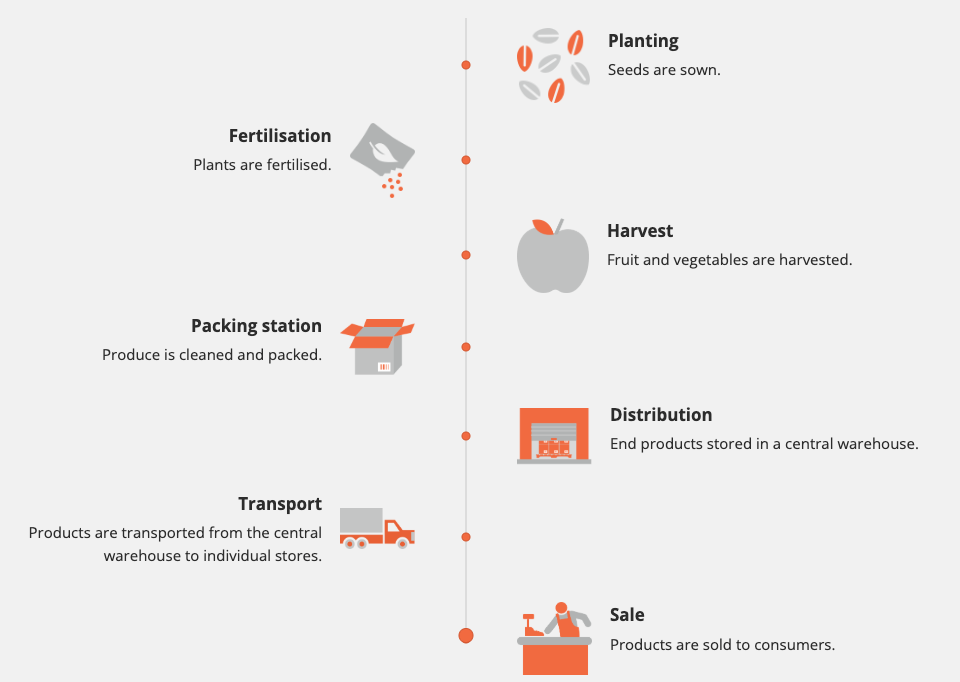
The following diagram depicts a typical supply chain for fruit and vegetable products. The individual process steps differ depending on the retail product. As a general rule, the more a product is processed, the higher the number of processing steps required.
Fruit and vegetables have been a focus of public interest alongside the demand for transparency in meat production since at least the EHEC crisis. Various regulatory requirements with regard to traceability and transparency are already in place, and these need to be taken into account. osapiens HUB enables a company to pool its own statutory data together with data from relevant upstream members of the chain, analyze it and make it available as required on a single shared platform.
The natural fluctuations in the yields of fruit and vegetable crops means that a certain flexibility is required when sourcing these products and raw materials. In terms of traceability, this represents major challenges for all companies and suppliers concerned. Supply chain partners vary, bringing with them data in different formats, and the introduction and management of new interfaces are always a source of inefficiencies. The osapiens platform offers a uniform, globally standardized language, interfaces to existing systems and differentiated permissions management, thereby ensuring the efficient and trusted exchange of data.
Under what conditions were fruit and vegetable products produced? Where do the raw materials come from? Do all companies involved have valid certificates? osapiens provides tangible opportunities to grow consumer trust in your own products by providing reliable data. Consumers can access supply chain data by scanning the QR code on the packaging or on the POS display.
Due to natural fluctuations in the yield of crops, fruit and vegetable supply chains are rarely self-contained. Production-related risks with respect to origin, quality and sustainability are a major challenge in the industry. In the event of a crisis, it is increasingly difficult to determine if – and how much – one’s own supply chain is concerned. With the help of integrated standards, it is possible to connect required data across companies along the entire supply chain to create transparency and sustainably reduce risks.