Current Status · 2026

EUDR 2026 – Current Status, Impact of the Delay & Concrete Recommendations for Action

What does the postponement of the EUDR mean for your business – and why preparation is crucial now.

LIVE WEBINAR

EUDR in 2026 – Your Next Step.

Date

The date will be announced after the FAQs are published.

Time

15:00 – 16:00 CET

Spots

Limited

Cost

Free
No theory overload. We’ll show you which steps make practical sense after the updates – what becomes simpler, what stays the same, and how to move your EUDR process forward pragmatically.
EUDR Delay · Current Status

What does the EUDR delay mean in practice?

What has been postponed?

The start of enforcement has been postponed to December 30, 2026 – for small and medium-sized enterprises (SMEs) to June 30, 2027. However, the regulation itself has been in force since June 2023.

What has NOT been postponed?

The fundamental due diligence obligation remains in place. Companies must continue to demonstrate that their EUDR-relevant products are deforestation-free.

What obligations exist?

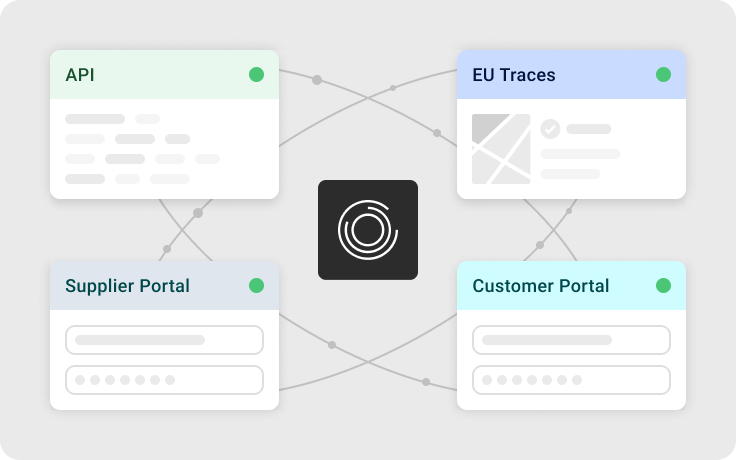
Geolocation data, risk assessments, supplier due diligence, and the use of the EU information system TRACES NT – all of this will be mandatory at the end of 2026.

What happens if companies wait?

Those who only begin implementing their internal EUDR processes when enforcement starts risk supply chain disruptions, fines, and reputational damage.


Find out whether your company falls within the scope of the EUDR.

For Importers

EUDR Compliance for Importers:
The three key due diligence obligations

Image

Collect supply chain information

Importers must collect detailed information about their supply chain. This includes in particular the geolocation of production plots, information on producers and suppliers, the affected products, quantities as well as relevant evidence of the legality of production.

This information forms the basis for the subsequent risk assessment under the EUDR.
Image

Conduct risk assessment

Companies must verify whether products are linked to deforestation after December 31, 2020 or are associated with violations of laws in the country of origin.
 
For this, a structured and traceable risk assessment is required. Only products with negligible risk may be placed on the EU market.
Image

Mitigate risks and submit due diligence statement

If the risk assessment identifies a non-negligible risk, companies must take appropriate risk mitigation measures, e.g., obtaining additional evidence or information.

Subsequently, a Due Diligence Statement (DDS) can be submitted in the EU system TRACES.
Your 5-Step Plan

What companies must do in 2026 concretely


1.Analyze your supply chain
Identify all relevant suppliers that produce EUDR-relevant raw materials.
2.Collect supplier data
Gather geolocation data for sourced raw materials together from your suppliers.
3.Conduct risk assessments
Assess the risks (deforestation, compliance with local laws) of each supplier and each region of origin systematically.
4.Submit reports in the EU TRACES system
Submit your due diligence statements for each relevant import via the EU TRACES information system.
5.Share EUDR data with customers
Provide your customers with reference numbers (“DDS”) and relevant EUDR documentation so that downstream companies can also fulfill their reporting obligations.
Image
Avoidable Risks

Common mistakes after the delay

“We still have time.”

The delay does not mean the obligation no longer applies. The clock is already ticking.

“We’ll collect the data in 2027.”

Companies that collect EUDR-relevant data too late risk supply chain disruptions at the beginning of 2027.

“Our suppliers will take care of it.”

The responsibility lies with the importer. Early supplier engagement is crucial.

“This only affects large companies.”

SMEs are also affected from June 2027 – with the same obligations..

“Our internal resources are sufficient.”

Without a systematic approach and digital processes, EUDR compliance will become a bottleneck.
EXCLUSIVE LIVE WEBINAR

EUDR in 2026 –
Your Next Step.

The EU Commission is releasing its EUDR updates — shortly after, we'll bring you up to speed on what it means for your business: which steps make sense, where processes can be simplified, and how to stay EUDR-ready.

Date

The date will be announced after the FAQs are published.

Time

15:00 - 16:00 CET

Spots

Limited

Cost

Free

What You’ll Take Away

What the EU Commission's updates mean for your business — in practice, not in theory

Practical simplifications & implementation tips you can act on immediately

Roadmap, risk assessment & open Q&A with Cattwyk

Reserve Your Spot

Termin wird zeitnah nach dem EU-Release bekannt gegeben.
Form:

Resource Center

EUDR Resources

Image

Webinar Series

Monthly sessions

EUDR Readiness 2026 — a living webinar series

Register now
Image

Blog

EUDR Update Dec. 2025: What changes for companies? 

Read now
Image

Guide

Selecting an EUDR Software: A Strategic Guide

Read now
Image

EUDR Guide

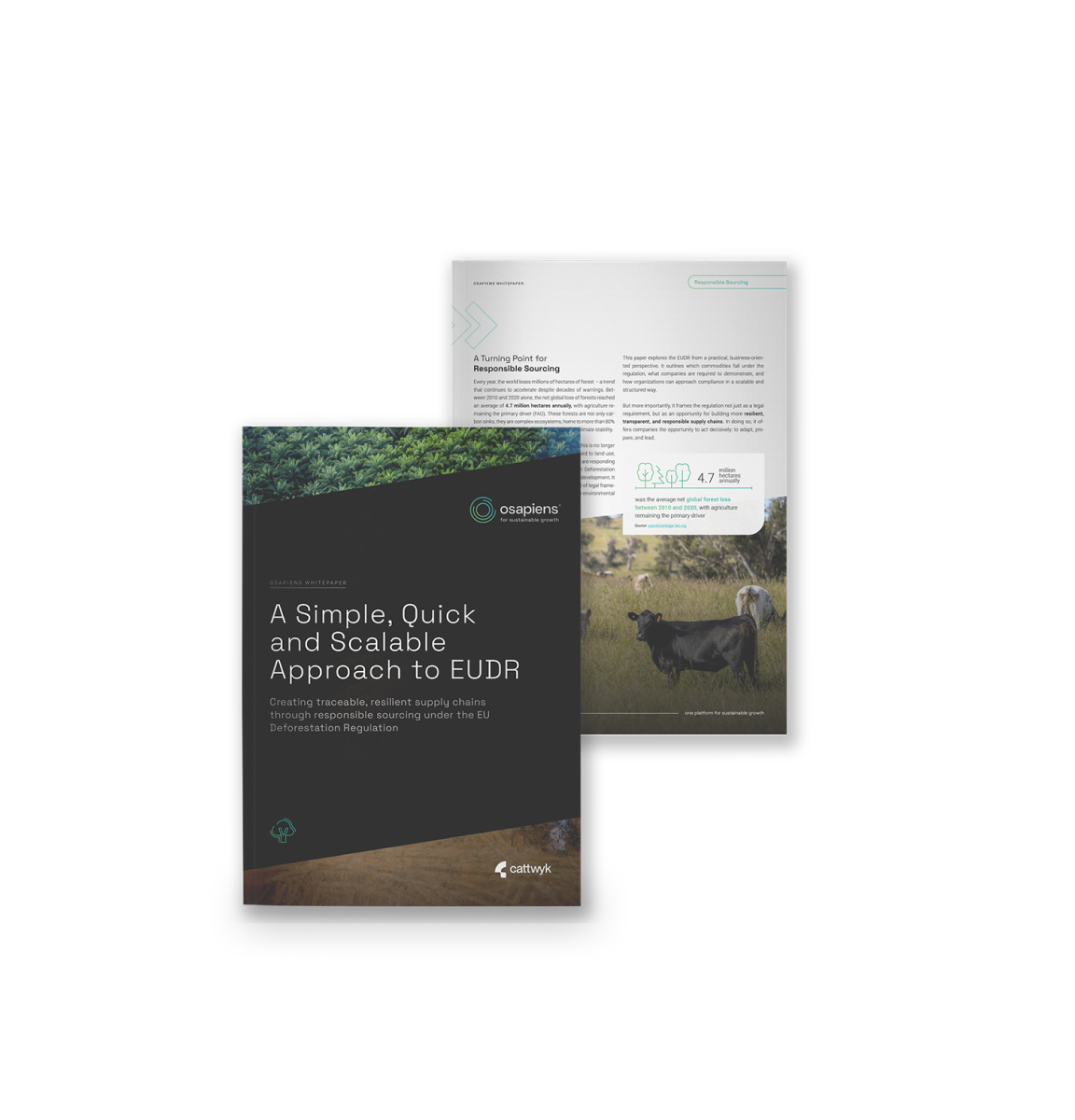
EUDR Guide – A simple, quick, and scalable approach to EUDR

Read now
Image

Guide

TRACES NT made simple – Your guide to login & registration

Read now
Image

Webinar

Monthly sessions in English

EUDR for First Operators — a practical webinar series for importers

Register now
Image

Checklist

EUDR for Importers Checklist

Download now

Achieve EUDR Compliance with Ease

Our software solution helps you maintain seamless EUDR compliance with automated traceability and risk management, ensuring you're always audit-ready.


Thousands of companies from all industries trust us

Image
Image
Image
Image
Image
Image

Frequently Asked Questions about the EU Deforestation Regulation (EUDR)