Community
osapeers.org
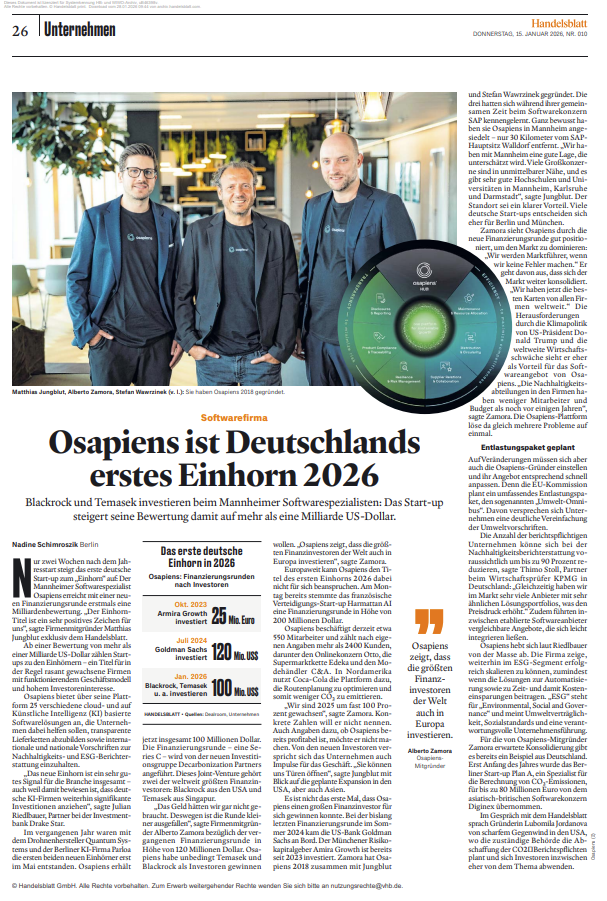
Handelsblatt, January 15, 2026, No. 010, Companies, p. 26
Software Company
Osapiens is Germany’s First Unicorn in 2026
Blackrock and Temasek invest in Mannheim-based software specialist: The start-up’s valuation rises to more than one billion US dollars.
Just two weeks into the new year, the first German start-up has achieved “unicorn” status: Mannheim-based software specialist Osapiens has reached a billion-dollar valuation for the first time with a new round of financing. “The unicorn title is a very positive sign for us,” company co-founder Matthias Jungblut told Handelsblatt exclusively.
Startups with a valuation of more than US$1 billion are considered unicorns – a title usually reserved for rapidly growing companies with a functioning business model and high investor interest.
Osapiens offers 25 different cloud-based and artificial intelligence (AI)-based software solutions via its platform, designed to help companies map transparent supply chains and comply with international and national regulations on sustainability and ESG reporting.
“The new unicorn is a very good sign for the industry as a whole – not least because it proves that German AI companies continue to attract significant investment,” said Julian Riedlbauer, partner at investment bank Drake Star.
Last year, the first two new unicorns, drone manufacturer Quantum Systems and Berlin-based AI company Parloa, were not created until May. Osapiens is now receiving a total of $100 million. The financing round – a Series C – is being led by the new investment group Decarbonization Partners. This joint venture is owned by two of the world’s largest financial investors: Blackrock from the US and Temasek from Singapore.
“We didn’t need the money at all. That’s why the round turned out to be smaller,” said company co-founder Alberto Zamora regarding the recent $120 million financing round. Osapiens was keen to attract Temasek and Blackrock as investors. “Osapiens shows that the world’s largest financial investors are also investing in Europe,” said Zamora.
Osapiens cannot claim the title of Europe’s first unicorn in 2026. On Monday, French defense start-up Harmattan AI secured a $200 million round of financing.
Osapiens currently employs around 550 people and, according to its own figures, has more than 2,400 customers, including the online group Otto, the supermarket chain Edeka, and the fashion retailer C&A. In North America, Coca-Cola uses the platform to optimize route planning and thus reduce CO₂ emissions.
“We have grown by almost 100 percent in 2025,” said Zamora. He does not want to give specific figures. Nor does he want to comment on whether Osapiens is already profitable. The company also expects the new investors to provide impetus for its business. “They can open doors for us,” said Jungblut, referring to the planned expansion in the US and Asia.
This is not the first time that Osapiens has attracted a major financial investor. In the most recent financing round in the summer of 2024, US bank Goldman Sachs came on board. Munich-based venture capitalist Amira Growth has been invested since 2023. Zamora founded Osapiens in 2018 together with Jungblut and Stefan Wawrzinek. The three had met during their time together at the software company SAP. They deliberately chose to locate Osapiens in Mannheim – just 30 kilometers from SAP’s headquarters in Walldorf. “Mannheim is a good location that is underestimated. Many large corporations are in the immediate vicinity, and there are very good colleges and universities in Mannheim, Karlsruhe, and Darmstadt,” said Jungblut. The location is a clear advantage. Many German start-ups tend to opt for Berlin and Munich.
Zamora believes that Osapiens is well positioned to dominate the market thanks to the new round of financing: “We will become the market leader if we don’t make any mistakes.” He expects the market to continue consolidating. “We now have the best cards of any company worldwide.” He sees the challenges posed by US President Donald Trump’s climate policy and the global economic downturn as more of an advantage for Osapiens’ software offering. “Sustainability departments in companies have fewer employees and smaller budgets than they did a few years ago,” said Zamora. The Osapiens platform solves several problems at once.
However, the founders of Osapiens must also prepare for changes and adapt their offerings accordingly. The EU Commission is planning a comprehensive relief package, known as the “Environmental Omnibus”. Companies expect this to significantly simplify environmental regulations.
The number of companies required to report on sustainability could be reduced by up to 90 percent, said Thimo Stoll, partner at auditing firm KPMG in Germany: “At the same time, we have a large number of providers in the market with very similar solution portfolios, which increases price pressure.” In addition, established software providers now offer comparable products that can be easily integrated.
According to Riedlbauer, Osapiens stands out from the crowd. The company continues to demonstrate its ability to scale successfully in the ESG segment, at least when its solutions contribute to automation and time and cost savings. “ESG” stands for “Environmental, Social and Governance” and refers to environmental compatibility, social standards, and responsible corporate governance.
There is already an example from Germany of the consolidation anticipated by Osapiens co-founder Zamora. At the beginning of the year, Berlin-based start-up Plan A, a specialist in calculating CO₂ emissions, was acquired by the Asian-British software group Diginex for up to €80 million.
In an interview with Handelsblatt, founder Lubomila Jordanova spoke of fierce headwinds in the US, where the relevant authority is planning to abolish CO2 reporting requirements and investors are now tending to turn away from the issue.
Caption:
Matthias Jungblut, Alberto Zamora, Stefan Wawrzinek (from left): They founded Osapiens in 2018.
Author: Nadine Schimroszik
Berlin
© Handelsblatt GmbH. All rights reserved.
© Handelsblatt print. Download on January 28, 2026, at 9:44 a.m. from archiv.handelsblatt.com.
About osapiens
osapiens – one platform for sustainable growth
osapiens develops software that empowers companies to drive sustainable growth across their entire value chain.
The osapiens HUB, a multi-tenant hyperscaler platform designed to enable cross-company collaboration and AI-automation, combines over 25 solutions in two categories: Transparency solutions enable companies to report on financial and non-financial data, manage supply chains, mitigate risk of all kinds (including cyber-risks and trade- and geo-political risks), and ensure compliance with product, reporting and supply chain regulations. Efficiency solutions enable AI-driven supplier collaboration, maintenance, service, and distribution processes to improve operational performance and strengthen competitiveness.
osapiens supports more than 2,400 customers worldwide, from SMEs to global enterprises across industries. Headquartered in Mannheim, Germany, with offices across Europe and the United States, the company works with an international team of over 550 employees.
Christian Feuring
External Communications Manager