EU Forced Labor Regulation: How To Prepare Your Supply Chain

Blog
Last edited: July 3, 2026
Read time 8 min.

Forced Labor is not a distant problem. According to the International Labor Organization (ILO), 27.6 million people are in forced labor worldwide, and that number has grown in recent years. Of them, 11.8 million are women and 3.3 million are children. Much of this labor is woven into global supply chains, which means it can reach the products sold in any market, including the European Union. 

The EU Forced Labor Regulation (Regulation (EU) 2024/3015), often shortened to the EUFLR, is the EU’s response to tackling forced labor. The EUFLR bans companies from placing products made with forced labor on the EU market, making them available there, or exporting them from the EU. The goal is twofold: to help keep forced Labor out of the goods Europeans buy and sell, and to support a fair, transparent marketplace where companies compete on a level playing field. It also contributes to the broader international effort to end forced labor, including the UN Sustainable Development Goal of eradicating it by 2030. 

Rather than telling companies to follow a specific process or carry out a particular set of checks, EUFLR sets a clear result they must achieve: no products made with forced labor. This obligation applies regardless of where the forced labor occurs, whether at a company’s own site or somewhere deep in its supply chain, and regardless of whether that supply chain runs inside or outside the EU. 

What does the EU Forced Labor Regulation cover? 

The EUFLR applies to all products made with forced labor, regardless of their origin, type, or sector, as long as those products are placed or made available on the EU market or exported from the EU market. The definition of “product” is also wider than in most EU product rules, unlike the New Legislative Framework (NLF), which covers manufactured goods like machinery, toys, and electronics. Alongside manufactured goods, the EUFLR covers agricultural products and extracted materials such as minerals and other raw materials. 

The rules apply from December 14, 2027, and cover products that are still being made available on the market, such as items on shelves or in warehouses. This applies to products even if they were made or imported before that date. 

Online and distance sales are also covered. This includes products sold through e-commerce sites or online marketplaces, provided that the offer targets buyers in the EU. Services are not included within EUFLR. 

The regulation applies to all economic operators that place products on the EU market, make them available within the EU, or export products from the EU. In practice, that includes producers, manufacturers, importers, exporters, retailers, and other product-chain actors. 

What counts as forced labor? 

The EUFLR uses the long-established definition from the International Labor Organization (ILO): any work or service exacted from a person under coercion, and for which the person has not offered themselves voluntarily. The definition focuses on two key elements: 

  • Coercion: This is the means used to force someone to work against their will. It can be physical, such as violence or restricting a worker’s movement, or financial, such as debt bondage, withholding wages, or confiscating identity documents. It also includes intimidation and threats, like threats of dismissal or deportation, and the abuse of a worker’s vulnerability. 
  • Lack of voluntary consent: “Voluntary” refers to a worker’s free and informed decision to take a job, and their freedom to leave it at any time. Consent is missing when a worker is deceived by false promises, subjected to unfree recruitment such as bonded labor, or pushed into work different from what was agreed without their agreement. 

How does the EU Forced Labor Regulation work in practice? 

The EUFLR prohibits products made with forced labor from being placed on or exported from the EU market. Enforcement is investigation-based and risk-based, led by the European Commission for suspected forced labor outside the EU and by national competent authorities for suspected forced labor within the EU. Businesses do not face a general EUFLR reporting duty, but they may need to provide information and evidence during investigations and should carry out due diligence to prepare. 

The investigation process runs through five steps: 
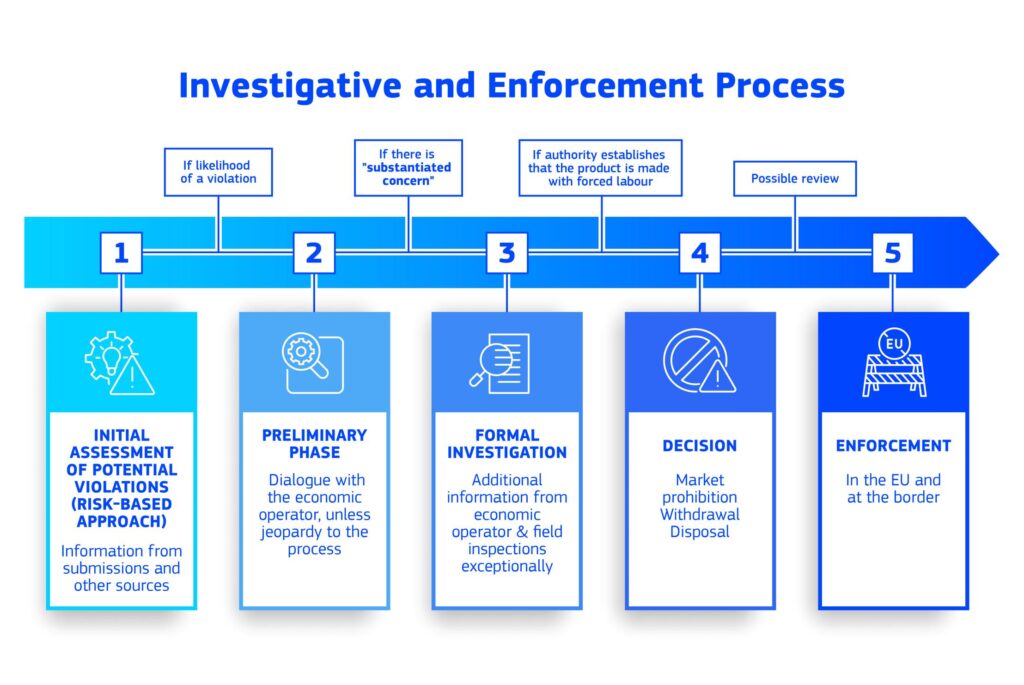
  1. Suspected forced labor cases are identified and reviewed: Authorities gather information about potential violations, including reports submitted to them, and decide which cases to prioritize. 
  1. Businesses may be asked to provide information: If there is reason for concern, authorities may ask the companies involved for additional information. If the concern remains, they open a formal investigation. 
  1. The company is investigated and given a chance to respond: Companies are told the reasons for the investigation and its scope, and they can submit documents or other information in response. In some cases, on-site inspections may take place. 
  1. Decisions are made on affected products: If forced labor is confirmed, the product is banned from the EU market and must be withdrawn and disposed of. Companies can request a review of the decision. 
  1. Product bans are enforced by customs and national authorities: Customs authorities enforce ban decisions at the EU’s external borders, and national authorities make sure products entering or leaving the EU market comply. Individual EU countries set the penalties for non-compliance. 
Source: European Commission

Why businesses should start preparing for the EU Forced Labor Regulation 

The EUFLR doesn’t require companies to run due diligence, file reports, or certify their supply chains. On paper, there’s nothing to submit, and no deadline aimed at businesses. That can make it easy to deprioritize. But a closer look at how the regulation works shows why waiting is a mistake. 

First, the ban is broad, and it lands on a fixed date. From December 14, 2027, any product made wholly or partly with forced labor is prohibited from the EU market, regardless of sector, origin, or how small the tainted component is. It also reaches products already made or imported before that date if they’re still on shelves or in warehouses. For most companies, “in scope” is the default, not the exception. 

Second, a product ban can affect businesses that were not part of the original investigation. EUFLR decisions apply to the specific products identified, rather than only to the company that was investigated. As a result, a ban linked to one company’s supply chain may also affect other businesses that sell the same product.  

Understanding your supply chain and maintaining evidence about your inputs can help demonstrate compliance and reduce the risk of being affected by a product ban triggered by another company’s supply chain. 

Key steps to EU Forced Labor Regulation readiness 

Mapping a supply chain across multiple tiers, gathering traceability data, and assembling the kind of records that can rebut a concern is not something you can prepare for in the weeks between a request and its deadline. In practice, this means taking several preparation steps: 

  • Start with visibility. Map your supply chain beyond the first tier, since forced labor risk usually sits deeper than direct suppliers, and identify where your products, components, and raw materials actually come from. 
  • Build the evidence base. The guidelines describe the kinds of information authorities may request, and it doubles as a useful readiness list: traceability data and supplier maps, purchase and shipping records, supplier codes of conduct, audit results, worker testimony, and records of any corrective actions taken. 
  • Use the risk tools available. The EU will maintain a forced labor risk database flagging higher-risk products and regions. Companies, especially smaller ones with limited resources, can use it to focus attention where risk is most likely rather than scrutinizing everything equally. 
  • Lean on the work you may already be doing. This is where other EU rules connect, but only where they genuinely overlap. Companies within scope of the Corporate Sustainability Due Diligence Directive (CSDDD) already have to identify and address human rights impacts, including forced labor, across their operations and value chains. This compliance process and the records it produces can help demonstrate that products are not linked to forced labor during an investigation. 

How osapiens supports EU Forced Labor Regulation readiness 

Preparing for the EU Forced Labor Regulation requires the same core capabilities needed for effective supply chain compliance: visibility into supplier networks, insight into potential risks, and documentation that can support regulatory reviews.  

The osapiens Supplier Intelligence Suite brings supply chain compliance, supplier risk management, and supplier management together in one platform, helping teams map their supply chains, assess supplier risks against relevant indicators, and maintain the documentation needed to respond to potential EUFLR investigations ahead of December 2027. 

Supply Chain Compliance | osapiens

Supplier Risk Management Platform | osapiens HUB

osapiens HUB for Supplier Relationship Mgmt. (SRM)


Forced Labor is not a distant problem. According to the International Labor Organization (ILO), 27.6 million people are in forced labor worldwide, and that number has grown in recent years. Of them, 11.8 million are women and 3.3 million are children. Much of this labor is woven into global supply chains, which means it can reach the products sold in any market, including the European Union. 

The EU Forced Labor Regulation (Regulation (EU) 2024/3015), often shortened to the EUFLR, is the EU’s response to tackling forced labor. The EUFLR bans companies from placing products made with forced labor on the EU market, making them available there, or exporting them from the EU. The goal is twofold: to help keep forced Labor out of the goods Europeans buy and sell, and to support a fair, transparent marketplace where companies compete on a level playing field. It also contributes to the broader international effort to end forced labor, including the UN Sustainable Development Goal of eradicating it by 2030. 

Rather than telling companies to follow a specific process or carry out a particular set of checks, EUFLR sets a clear result they must achieve: no products made with forced labor. This obligation applies regardless of where the forced labor occurs, whether at a company’s own site or somewhere deep in its supply chain, and regardless of whether that supply chain runs inside or outside the EU. 

What does the EU Forced Labor Regulation cover? 

The EUFLR applies to all products made with forced labor, regardless of their origin, type, or sector, as long as those products are placed or made available on the EU market or exported from the EU market. The definition of “product” is also wider than in most EU product rules, unlike the New Legislative Framework (NLF), which covers manufactured goods like machinery, toys, and electronics. Alongside manufactured goods, the EUFLR covers agricultural products and extracted materials such as minerals and other raw materials. 

The rules apply from December 14, 2027, and cover products that are still being made available on the market, such as items on shelves or in warehouses. This applies to products even if they were made or imported before that date. 

Online and distance sales are also covered. This includes products sold through e-commerce sites or online marketplaces, provided that the offer targets buyers in the EU. Services are not included within EUFLR. 

The regulation applies to all economic operators that place products on the EU market, make them available within the EU, or export products from the EU. In practice, that includes producers, manufacturers, importers, exporters, retailers, and other product-chain actors. 

What counts as forced labor? 

The EUFLR uses the long-established definition from the International Labor Organization (ILO): any work or service exacted from a person under coercion, and for which the person has not offered themselves voluntarily. The definition focuses on two key elements: 

  • Coercion: This is the means used to force someone to work against their will. It can be physical, such as violence or restricting a worker’s movement, or financial, such as debt bondage, withholding wages, or confiscating identity documents. It also includes intimidation and threats, like threats of dismissal or deportation, and the abuse of a worker’s vulnerability. 
  • Lack of voluntary consent: “Voluntary” refers to a worker’s free and informed decision to take a job, and their freedom to leave it at any time. Consent is missing when a worker is deceived by false promises, subjected to unfree recruitment such as bonded labor, or pushed into work different from what was agreed without their agreement. 

How does the EU Forced Labor Regulation work in practice? 

The EUFLR prohibits products made with forced labor from being placed on or exported from the EU market. Enforcement is investigation-based and risk-based, led by the European Commission for suspected forced labor outside the EU and by national competent authorities for suspected forced labor within the EU. Businesses do not face a general EUFLR reporting duty, but they may need to provide information and evidence during investigations and should carry out due diligence to prepare. 

The investigation process runs through five steps: 

  1. Suspected forced labor cases are identified and reviewed: Authorities gather information about potential violations, including reports submitted to them, and decide which cases to prioritize. 
  1. Businesses may be asked to provide information: If there is reason for concern, authorities may ask the companies involved for additional information. If the concern remains, they open a formal investigation. 
  1. The company is investigated and given a chance to respond: Companies are told the reasons for the investigation and its scope, and they can submit documents or other information in response. In some cases, on-site inspections may take place. 
  1. Decisions are made on affected products: If forced labor is confirmed, the product is banned from the EU market and must be withdrawn and disposed of. Companies can request a review of the decision. 
  1. Product bans are enforced by customs and national authorities: Customs authorities enforce ban decisions at the EU’s external borders, and national authorities make sure products entering or leaving the EU market comply. Individual EU countries set the penalties for non-compliance. 
Source: European Commission

Why businesses should start preparing for the EU Forced Labor Regulation 

The EUFLR doesn’t require companies to run due diligence, file reports, or certify their supply chains. On paper, there’s nothing to submit, and no deadline aimed at businesses. That can make it easy to deprioritize. But a closer look at how the regulation works shows why waiting is a mistake. 

First, the ban is broad, and it lands on a fixed date. From December 14, 2027, any product made wholly or partly with forced labor is prohibited from the EU market, regardless of sector, origin, or how small the tainted component is. It also reaches products already made or imported before that date if they’re still on shelves or in warehouses. For most companies, “in scope” is the default, not the exception. 

Second, a product ban can affect businesses that were not part of the original investigation. EUFLR decisions apply to the specific products identified, rather than only to the company that was investigated. As a result, a ban linked to one company’s supply chain may also affect other businesses that sell the same product.  

Understanding your supply chain and maintaining evidence about your inputs can help demonstrate compliance and reduce the risk of being affected by a product ban triggered by another company’s supply chain. 

Key steps to EU Forced Labor Regulation readiness 

Mapping a supply chain across multiple tiers, gathering traceability data, and assembling the kind of records that can rebut a concern is not something you can prepare for in the weeks between a request and its deadline. In practice, this means taking several preparation steps: 

  • Start with visibility. Map your supply chain beyond the first tier, since forced labor risk usually sits deeper than direct suppliers, and identify where your products, components, and raw materials actually come from. 
  • Build the evidence base. The guidelines describe the kinds of information authorities may request, and it doubles as a useful readiness list: traceability data and supplier maps, purchase and shipping records, supplier codes of conduct, audit results, worker testimony, and records of any corrective actions taken. 
  • Use the risk tools available. The EU will maintain a forced labor risk database flagging higher-risk products and regions. Companies, especially smaller ones with limited resources, can use it to focus attention where risk is most likely rather than scrutinizing everything equally. 
  • Lean on the work you may already be doing. This is where other EU rules connect, but only where they genuinely overlap. Companies within scope of the Corporate Sustainability Due Diligence Directive (CSDDD) already have to identify and address human rights impacts, including forced labor, across their operations and value chains. This compliance process and the records it produces can help demonstrate that products are not linked to forced labor during an investigation. 

How osapiens supports EU Forced Labor Regulation readiness 

Preparing for the EU Forced Labor Regulation requires the same core capabilities needed for effective supply chain compliance: visibility into supplier networks, insight into potential risks, and documentation that can support regulatory reviews.  

The osapiens Supplier Intelligence Suite brings supply chain compliance, supplier risk management, and supplier management together in one platform, helping teams map their supply chains, assess supplier risks against relevant indicators, and maintain the documentation needed to respond to potential EUFLR investigations ahead of December 2027. 

Supply Chain Compliance | osapiens

Supplier Risk Management Platform | osapiens HUB

osapiens HUB for Supplier Relationship Mgmt. (SRM)