Community
osapeers.org
This article is available in
About this article

Jessica Hollfelder
AuthorAssigned categories
Most mid-sized maintenance teams know the moment well: a line goes down and the technician who knows the machine best is on vacation.
This is what maintenance often looks like at mid-sized companies after a few years of growth: a working system held together by experienced people, sticky notes on machines, and shared Excel files. It works until it doesn’t. And once it stops working, the cost shows up immediately in lost production hours, overtime, and asset downtime.
Smart maintenance offers a way forward. Getting to a structured maintenance setup does not require a dedicated reliability engineer or a six-month rollout. It requires a tool that understands what structured maintenance actually means for an SME, and then building toward it in the right sequence. With osapiens HUB for Maintenance, SMEs can start on a free plan and scale from there.
Structured maintenance is often confused with complex maintenance, but the difference matters. For an SME, structured maintenance means four specific things:
A structured setup makes all four achievable with the team you already have. For most SMEs, the challenge is the absence of a system that holds the structure in place, rather than a question of capability.
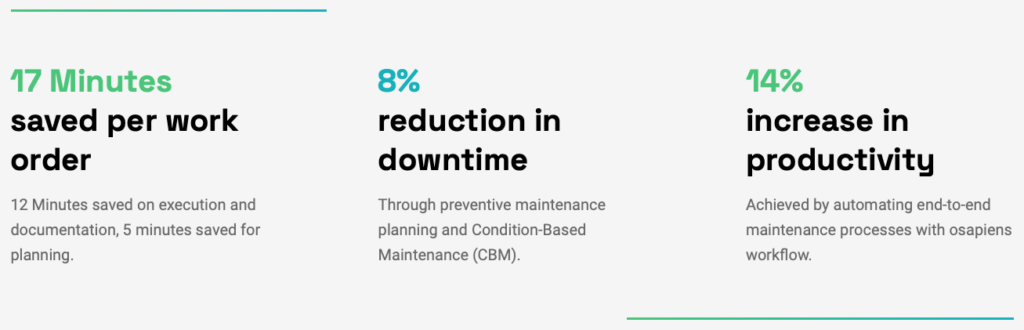
A structured maintenance setup with osapiens HUB for Maintenance creates measurable savings across three areas. SMEs see the impact in the first months.
Less downtime
Mid-sized companies running osapiens HUB for Maintenance see downtime reductions of around 8% through preventive scheduling and condition-based triggers. For manufacturing SMEs where one hour of unplanned downtime can run into five-figure losses, that adds up to a meaningful annual saving.
More productive technician hours
Structured digital workflows in osapiens save approximately 17 minutes per work order: 12 minutes on execution and documentation, and 5 minutes in planning. Across a team of ten technicians completing 20 orders a day, that translates into an additional hour of productive maintenance time per technician per day.
Working capital released from spare parts
Connected parts, assets, and reorder thresholds in osapiens reduce duplicate purchases and slow-moving stock kept “just in case”. Capital that used to sit on shelves goes back into the business.
These savings show up across the operation: more delivery dates met on time, predictable maintenance budgets, and a team that spends more time improving and less time firefighting.
The path from sticky notes to structured maintenance with osapiens follows four steps. Each one builds on the previous and can be implemented in weeks rather than months. Here is the sequence that works.
The foundation of structured maintenance is knowing what you actually have to maintain. Before scheduling any task or tracking any work order, every asset that needs maintenance has to exist in one list. This includes equipment ID, location, criticality, manufacturer, and key documents in a single record.
What this can look like in practice: a food production SME with two facilities walks the shop floor with a tablet. Each machine gets a QR code, a clear photo, and an entry in the asset register with model, year, and supplier contact. The exercise reveals two pieces of equipment with no recorded service history and one with a warranty that expires next month.
Once every asset is registered, work can be assigned to it.
The second step is to bring all work order activity into one place: the osapiens CMMS. Reactive repairs, scheduled tasks, inspection findings, and technician notes all go into the same system, linked to the asset they relate to.
What this can look like in practice: a packaging manufacturer routes every maintenance request through a simple ticket form, replacing the previous mix of messages and walk-up requests. Within a few weeks, every active asset has a documented work history, and the production manager can see at a glance which lines are accumulating reactive repairs and might benefit from preventive attention.
With history in one place, patterns become visible.
The third step is the operational heart of structured maintenance. Recurring tasks such as lubrication, filter changes, calibrations, and safety inspections are defined once and scheduled automatically based on time, runtime, or condition. The system generates the work order, assigns it to the right technician, and sends reminders before due dates.
For SMEs, the value compounds quickly. Each task moved from reactive to preventive removes a future emergency call from the queue. Maintenance workload distributes across the year rather than concentrating in crisis moments.
What this can look like in practice: a logistics SME running a fleet of conveyors and forklifts defines twelve preventive maintenance plans across its three sites. Each plan triggers automatically: every 250 operating hours for forklifts, every quarter for conveyor belts, every twelve months for fire suppression checks. The site manager no longer maintains a master schedule manually. Compliance evidence for safety audits is generated automatically alongside the work.
Preventive scheduling is what most teams have wanted for years. What tends to be missing is the setup that makes it sustainable.
The final step closes the loop. Spare parts are connected to the assets that use them. Stock levels update automatically as parts are consumed in work orders. Reorder thresholds trigger purchase requests before stockouts. Suppliers are stored at the part level, so reordering becomes a one-click operation rather than a search.
What this can look like in practice: a chemical processing SME with 800 spare parts across two warehouses runs a one-time data cleanup, removing duplicate entries and assigning each part to a labeled bin with a QR code. Parts are linked to the assets they belong to. Six months later, stockouts are down significantly, and the maintenance manager has clear data on which parts move fast, which are slow-moving capital, and which suppliers are reliable.
This is the step that turns a digital work order system into an operating platform for the whole maintenance function.
These four steps work at any scale. At a certain point, however, manual execution stops being viable. Purpose-built maintenance software for SMEs accelerates each of the four steps and makes them less dependent on individual effort.
osapiens EASY START for Maintenance is built around exactly this starting point. The asset register, work order management, preventive scheduling, and parts and inventory tracking sit in one platform. The mobile app works offline for technicians on the shop floor. SAP integration keeps procurement and finance systems in sync. Pre-built templates and checklists allow teams to get started within days rather than months.
What matters most: the platform is available with a free plan, so SMEs can build their asset register and run their first preventive maintenance schedules without upfront investment. When the team is ready to scale, the same system grows with the operation, from a single site to multi-entity deployments across countries.
For mid-sized companies currently running maintenance on Excel and tribal knowledge, the practical effect is a shift from a setup that costs production hours and ties up capital to one where structured maintenance is the routine output, with the team you already have.
Start your free trial and run your first work orders this week.